Why Microsoft Sits at the Center of the Cloud and AI Era: Azure, Copilot, and Office Explained [eng]

Why Microsoft Sits at the Center of the Cloud and AI Era
A company-analysis guide to Azure, Microsoft 365, Copilot, Windows, gaming, and the OpenAI partnership.
- Microsoft is no longer just a software company. It is a platform company built around cloud, productivity software, operating systems, AI, security, and gaming.
- The core investment logic is Azure plus Microsoft 365 subscriptions, with Copilot and AI features layered on top to increase value per user.
- Investors should watch Azure growth, AI monetization, Microsoft 365 pricing power, security demand, gaming integration, and valuation risk.
One-line summary and overview
Microsoft is still famous for Windows and Office, but the current company is much broader than the old PC-software story. Today, the market sees Microsoft as a cloud and enterprise productivity platform that is turning AI into a product layer.
In one sentence, Microsoft is a company that helps businesses run work, data, security, cloud infrastructure, and AI through one deeply integrated ecosystem. For consumers, Windows, Excel, and Xbox may be the familiar names. For enterprises, Microsoft is often the default IT partner for email, documents, meetings, identity, security, databases, cloud, analytics, and AI tools.
Business structure
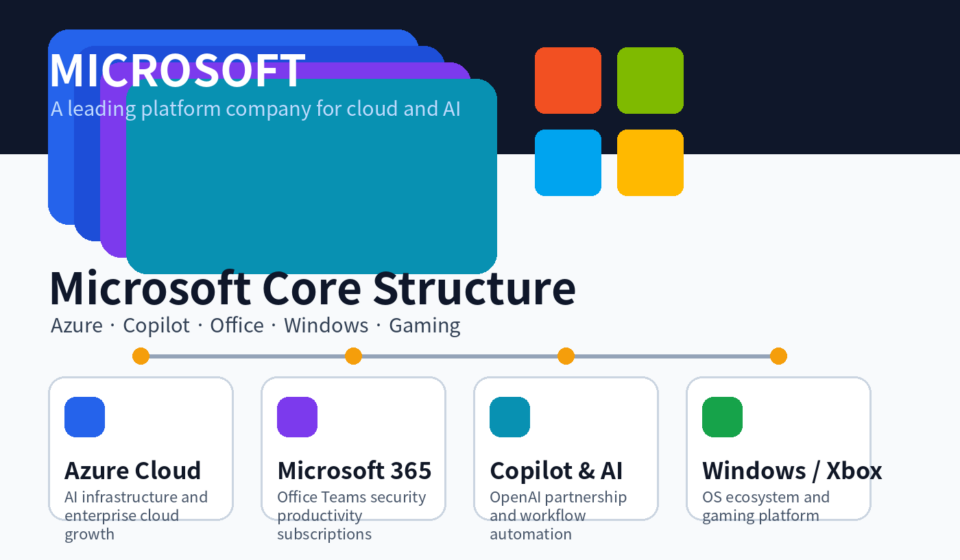
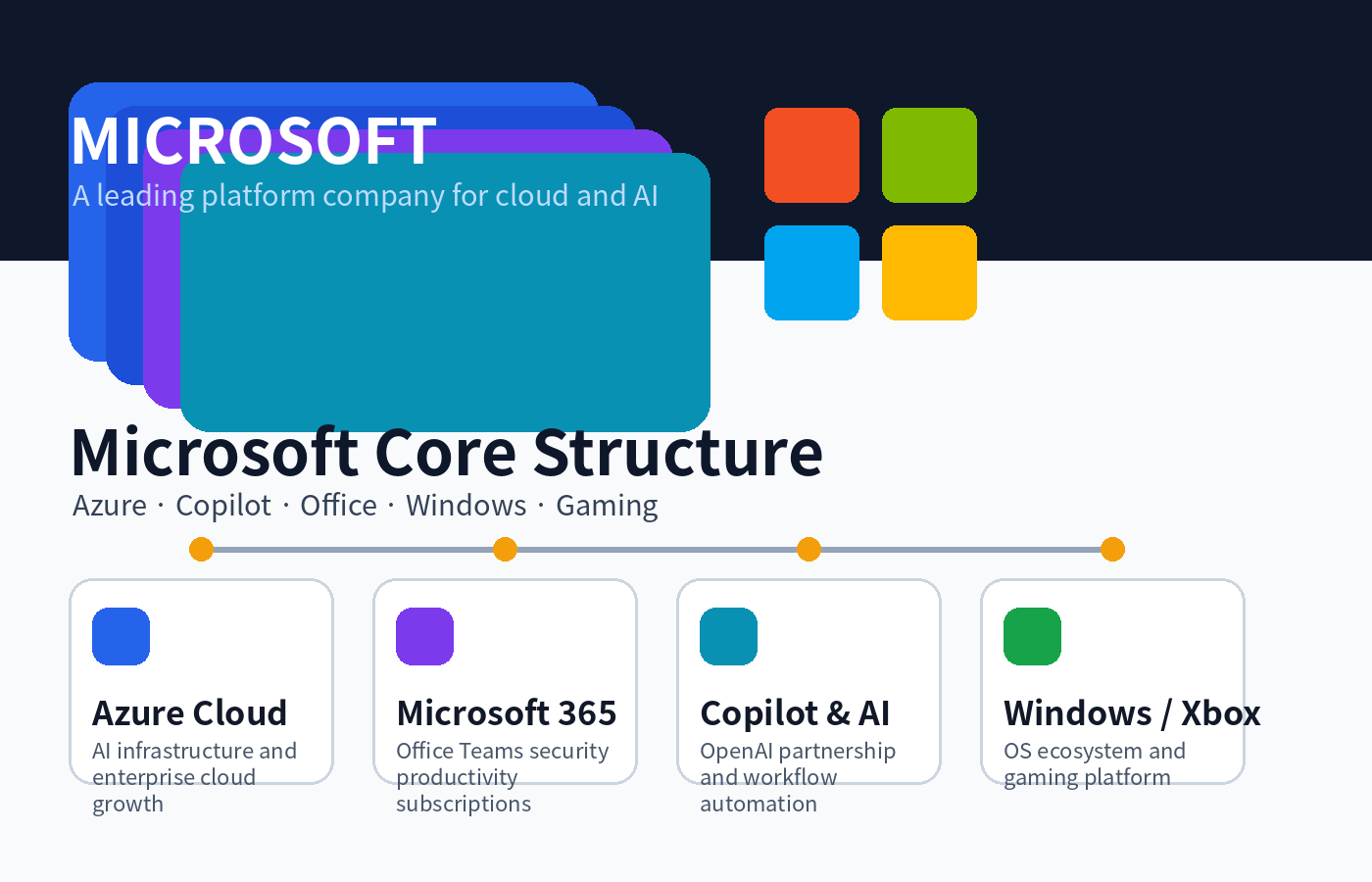
Microsoft’s business can be understood through three major areas: productivity and business processes, intelligent cloud, and personal computing. In plain English, this means Microsoft 365 and LinkedIn, Azure and server products, plus Windows, devices, search, and Xbox.
The most important growth engine is Azure. Azure competes with Amazon AWS and Google Cloud as a global cloud platform. As companies move workloads from their own servers to the cloud, they need compute power, storage, databases, developer tools, cybersecurity, and AI infrastructure. Azure sits at the center of that demand.
Another important pillar is Microsoft 365. Word, Excel, PowerPoint, Outlook, Teams, SharePoint, and security tools are delivered as subscription products. Once a large organization adopts them across employees, switching away becomes difficult. That creates durable recurring revenue.
Key products and services
Windows and Office remain important, but Microsoft’s growth story now depends more on Azure, Microsoft 365, Dynamics, LinkedIn, GitHub, security products, and Copilot. Each of these products reinforces the others.
Copilot is especially important because it shows how Microsoft wants to commercialize AI. Instead of offering AI only as a separate chatbot, Microsoft embeds AI into tools people already use: documents, spreadsheets, email, meetings, code editors, CRM systems, and cloud workflows.
GitHub Copilot targets developers, Microsoft 365 Copilot targets knowledge workers, and Azure AI services target enterprise developers and data teams. This gives Microsoft many surfaces where AI can become a paid productivity layer.
AI and cloud strategy
To understand Microsoft’s AI strategy, you have to look at Azure and the OpenAI partnership together. The popularity of large language models creates demand for cloud infrastructure, GPUs, data centers, model hosting, and enterprise AI services. Microsoft can capture that demand through Azure.
The strategy is powerful because AI can support both infrastructure revenue and software revenue. If more AI workloads run on Azure, cloud usage can grow. If more companies adopt Copilot, Microsoft 365 revenue per user can rise. In other words, Microsoft is trying to turn AI from a theme into a monetizable layer across its product portfolio.
For AI infrastructure context, see Nvidia. For cloud competition, compare Microsoft with Amazon AWS and Alphabet Google Cloud.
Competitor comparison
Microsoft’s closest cloud competitors are Amazon and Alphabet. AWS remains the original cloud leader, while Google Cloud is strong in AI, data analytics, and developer infrastructure. Microsoft’s advantage is its enterprise customer base and the ability to bundle Azure with identity, security, Office, Teams, and enterprise software.
In productivity software, Microsoft competes with Google Workspace, Slack, Zoom, Salesforce, and other collaboration platforms. However, Microsoft 365 combines documents, email, meetings, identity, administration, and security in one package, which makes it sticky for large companies and public-sector customers.
In enterprise IT, Microsoft can also be compared with IBM. IBM is more focused on hybrid cloud, consulting, Red Hat, and legacy enterprise systems, while Microsoft is stronger in cloud platforms and daily productivity tools.
Strengths
The first strength is recurring revenue. Microsoft 365, Azure, security products, server tools, and enterprise software are used for long periods. Once a company standardizes on Microsoft, switching costs can be high.
The second strength is product surface area. Microsoft can add AI to Word, Excel, Outlook, Teams, GitHub, Dynamics, Azure, and security tools. That gives the company many ways to turn AI features into paid products.
The third strength is financial capacity. Microsoft generates strong cash flow, which allows it to invest in data centers, AI chips, cloud capacity, research, acquisitions, and developer ecosystems. In a long AI race, capital strength matters.
Risks and weaknesses
The first risk is high expectations. Microsoft is already viewed as one of the highest-quality companies in the world. If Azure growth slows or Copilot adoption disappoints, the stock can still be pressured because expectations are high.
The second risk is AI infrastructure cost. AI services require expensive data centers, GPUs, networking equipment, and electricity. If Copilot or Azure AI revenue does not scale fast enough, investors may question the return on those investments.
The third risk is regulation. Microsoft operates across cloud, AI, software bundling, security, gaming, search, and enterprise platforms. Large technology companies face constant scrutiny around competition, data, and market power.
Financial and valuation checkpoints
The first number to watch is Azure growth. Investors want to see whether AI demand is actually turning into cloud consumption. The second checkpoint is Microsoft 365 pricing power and Copilot adoption. If users pay more for AI-enhanced productivity tools, the revenue impact can be meaningful.
The third checkpoint is operating margin. Microsoft must keep investing heavily in cloud and AI infrastructure while defending profitability. The fourth checkpoint is capital expenditure. Large data-center spending can support future growth, but it also raises near-term cash-flow questions.
Valuation should not be ignored. Microsoft is a high-quality business, but great companies can still be expensive stocks. Investors should compare expected growth, margins, AI monetization, and the current share price together.
Current trends and Microsoft’s position
The most important technology trends today are AI, cloud, cybersecurity, and data centers. Microsoft is exposed to all of them. Azure benefits from cloud and AI workloads, Microsoft 365 Copilot targets everyday work, and Microsoft Defender connects to the rising demand for enterprise security.
When companies adopt AI, they often prefer tools that fit into workflows they already use. This is where Microsoft has an advantage. If AI lives inside Outlook, Teams, Excel, Word, GitHub, and Azure, adoption can be easier than asking employees to move to entirely new tools.
Conclusion
Microsoft has transformed from a Windows-centered software company into one of the most important cloud and AI platforms in the world. Azure provides the growth engine, Microsoft 365 provides durable recurring revenue, and Copilot represents the next layer of AI monetization.
The key question is not simply whether Microsoft is a good company. It clearly is. The harder question is whether the current price already reflects too much of the future. Long-term investors should watch Azure growth, Copilot adoption, AI infrastructure costs, regulation, and valuation together.
Additional questions for investors
- Separate one-time product revenue from recurring or platform-style revenue.
- Ask what needs to happen before the current news can become visible earnings.
- Compare pricing power, customer base, technology position, and margin profile with competitors.
- Watch operating margin and free cash flow, not only headline revenue growth.
- Consider whether the stock price already reflects an optimistic scenario.
Public sources and editorial basis
This article is an explanatory guide based on publicly available materials such as company investor-relations pages, annual reports, quarterly earnings releases, official product or service announcements, and industry context. It is rewritten in plain language with emphasis on business model, revenue drivers, risks, and practical signals to watch. It is for education and information only, not a buy or sell recommendation.
Editorial basis and how to read this article
This article is based on publicly available company materials, filings, earnings releases, official announcements, market data, and news context. It is written as a plain-language explainer, not as a short-term price prediction. It is for education and information only and is not a buy or sell recommendation.
Reader checklist
- Check the date and source of key numbers.
- Compare headlines with actual earnings, filings, and market data.
- Look for both growth drivers and risks.
- Separate the business model from the stock narrative.
- Review the next earnings release or official update before making your own decision.