
Why Amazon Still Sits at the Center of E-commerce, AWS, and the AI Shift [eng]
A company-analysis guide to e-commerce, AWS, advertising, logistics, and Amazon’s AI strategy.
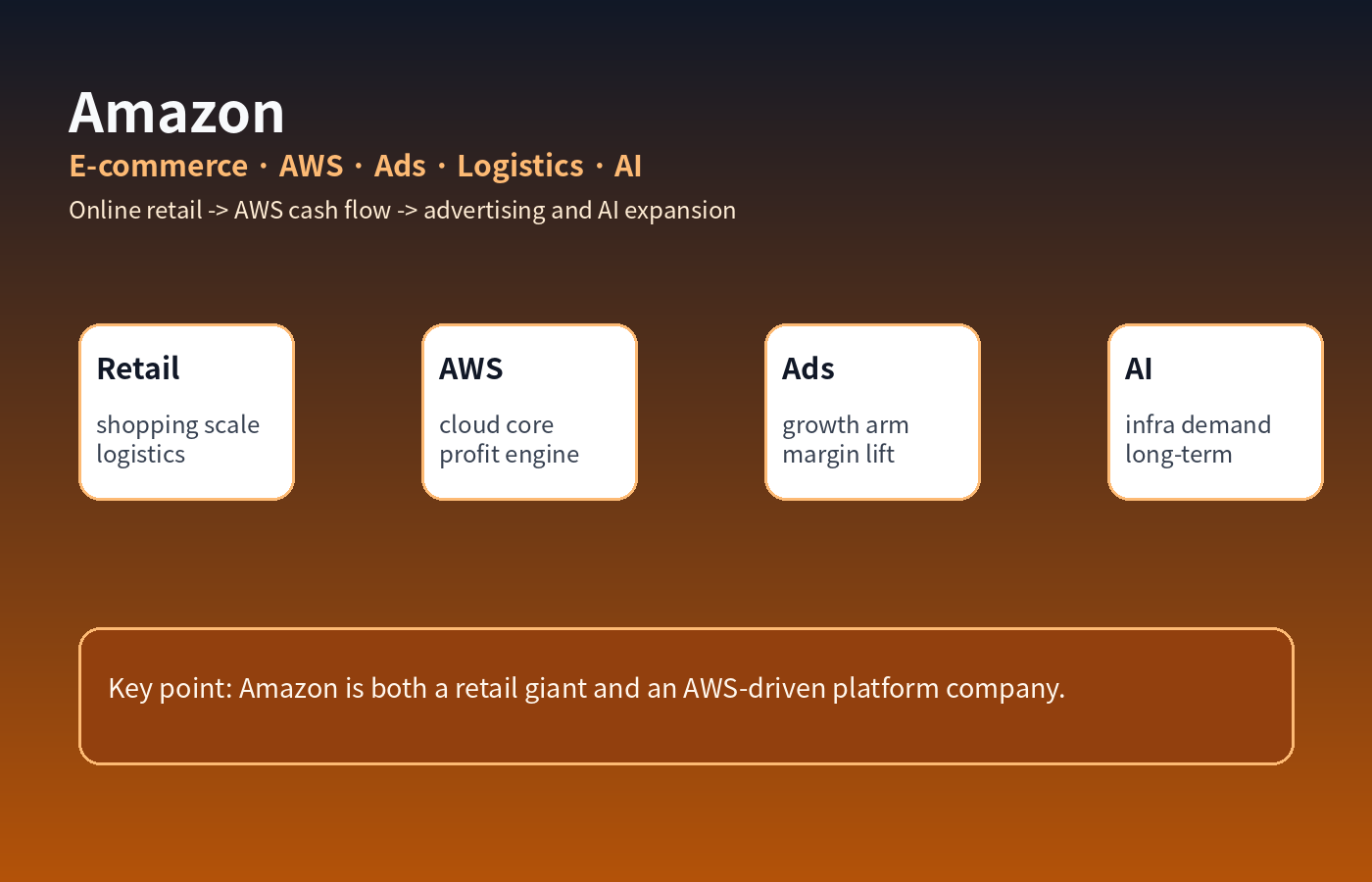
- Amazon is not just an online retailer. It is a platform built on e-commerce, AWS, advertising, logistics, and AI.
- The core story is the combination of Amazon’s massive retail scale and AWS’s high-quality profit engine.
- Readers should follow consumer demand, cloud growth, ad monetization, logistics efficiency, and AI investment together.
One-line summary and overview
Amazon is one of the largest e-commerce companies in the world, but the market does not treat it as a simple retailer. The key reason is AWS. Amazon combines a huge consumer-commerce platform with one of the most important cloud businesses in the market.
A useful one-line summary would be: Amazon brings users in through commerce, earns high-quality profits through AWS, and expands through advertising, logistics, and AI.
Business structure
Amazon’s structure can be viewed through online stores, third-party marketplace activity, advertising, AWS, subscriptions like Prime, and logistics. Consumers usually think of Amazon as a shopping destination, but investors often focus much more heavily on AWS and margin quality.
That is because AWS has often carried the strongest profitability profile inside Amazon, while advertising has emerged as an increasingly important high-margin growth engine.
Core services and why they matter
- Amazon E-commerce — scale and user traffic
- AWS — profit engine and growth core
- Advertising — margin expansion driver
- Prime — loyalty and ecosystem retention
- Logistics — cost structure and competitive moat
So Amazon is better understood not simply as a company that sells goods, but as a platform where commerce, cloud, advertising, and infrastructure reinforce each other.
Competitor comparison
In retail and marketplace terms, Amazon is compared with Walmart, Shopify’s merchant ecosystem, and various global e-commerce platforms. In cloud, Microsoft Azure and Google Cloud are the most important comparisons. In digital monetization, Google and Meta also matter because Amazon’s ad business is increasingly relevant.
- Walmart — retail and omnichannel competition
- Shopify — merchant ecosystem comparison
- Microsoft / Google — cloud competition
- Google / Meta — digital ad competition
Strengths
- Massive e-commerce scale — strong user and seller network effects
- AWS profitability — one of the company’s most important value drivers
- Advertising growth — high-margin expansion potential
- Logistics infrastructure — difficult for competitors to replicate quickly
- AI investment capacity — tied to cloud and infrastructure demand
Weaknesses and risks
- Consumer-demand sensitivity — retail demand can soften in weaker economic periods
- Logistics cost pressure — scale requires constant efficiency discipline
- Cloud competition — Microsoft and Google remain serious rivals
- Regulatory pressure — antitrust and marketplace dominance issues remain relevant
Financial and valuation checkpoints
Amazon should not be read only through total revenue. The more useful lens is AWS growth, advertising momentum, operating margin, and logistics efficiency. Valuation often reflects platform and cloud characteristics rather than traditional retail comparison alone.
- AWS revenue growth and margin profile
- Advertising growth rate
- North America / International retail profitability
- Capital expenditure and AI infrastructure investment
Current trends and Amazon’s position
The main trend around Amazon today is AWS and AI. Retail remains the customer-facing foundation, but the market increasingly reads Amazon as a cloud and AI infrastructure platform rather than only a commerce business.
At the same time, advertising is becoming a more important monetization pillar. That means Amazon is not only a retail platform anymore. It is also becoming a bigger digital monetization platform in ways that overlap with other major tech players.
Conclusion
Amazon matters not just because it is a huge retailer, but because e-commerce scale, AWS profitability, advertising growth, logistics infrastructure, and AI investment all work together inside one company.
The key frame is AWS growth, e-commerce efficiency, advertising monetization, and AI investment flow.
FAQ
What is Amazon’s most important business?
Consumers think first of shopping, but investors often focus most heavily on AWS.
Is Amazon well positioned for the AI era?
Yes, especially through AWS and its role in cloud and data-center infrastructure.
What numbers should readers watch first?
AWS growth, operating margins, ad growth, and logistics efficiency are strong starting points.
For the platform and advertising side, read Why Alphabet Still Sits at the Center of Search, Ads, and the AI Shift [eng].
For the infrastructure side of AI, see Why Nvidia Sits at the Center of the AI Era [eng].
Additional questions for investors
- Separate one-time product revenue from recurring or platform-style revenue.
- Ask what needs to happen before the current news can become visible earnings.
- Compare pricing power, customer base, technology position, and margin profile with competitors.
- Watch operating margin and free cash flow, not only headline revenue growth.
- Consider whether the stock price already reflects an optimistic scenario.
Public sources and editorial basis
This article is an explanatory guide based on publicly available materials such as company investor-relations pages, annual reports, quarterly earnings releases, official product or service announcements, and industry context. It is rewritten in plain language with emphasis on business model, revenue drivers, risks, and practical signals to watch. It is for education and information only, not a buy or sell recommendation.
How to read Amazon earnings step by step
Start with AWS. AWS is one of the most important profit drivers for Amazon, and it is directly connected to enterprise cloud and AI infrastructure demand. If AWS growth accelerates while margins hold, the market usually views that as a strong signal.
Second, look at North America retail profitability. Amazon’s retail business has huge scale but also high fulfillment, shipping, and labor costs. Revenue growth alone is not enough; investors need to see whether logistics efficiency and advertising can lift operating margin.
Third, watch advertising. Amazon’s ads are powerful because they appear close to the purchase decision. If advertising keeps growing, it can improve the economics of the marketplace and make the retail platform more profitable.
Editorial basis and how to read this article
This article is based on publicly available company materials, filings, earnings releases, official announcements, market data, and news context. It is written as a plain-language explainer, not as a short-term price prediction. It is for education and information only and is not a buy or sell recommendation.
Reader checklist
- Check the date and source of key numbers.
- Compare headlines with actual earnings, filings, and market data.
- Look for both growth drivers and risks.
- Separate the business model from the stock narrative.
- Review the next earnings release or official update before making your own decision.