
Hynix History Explained
From Hyundai Electronics to SK hynix, this longer English article explains the company’s path in a clearer, more structured way.
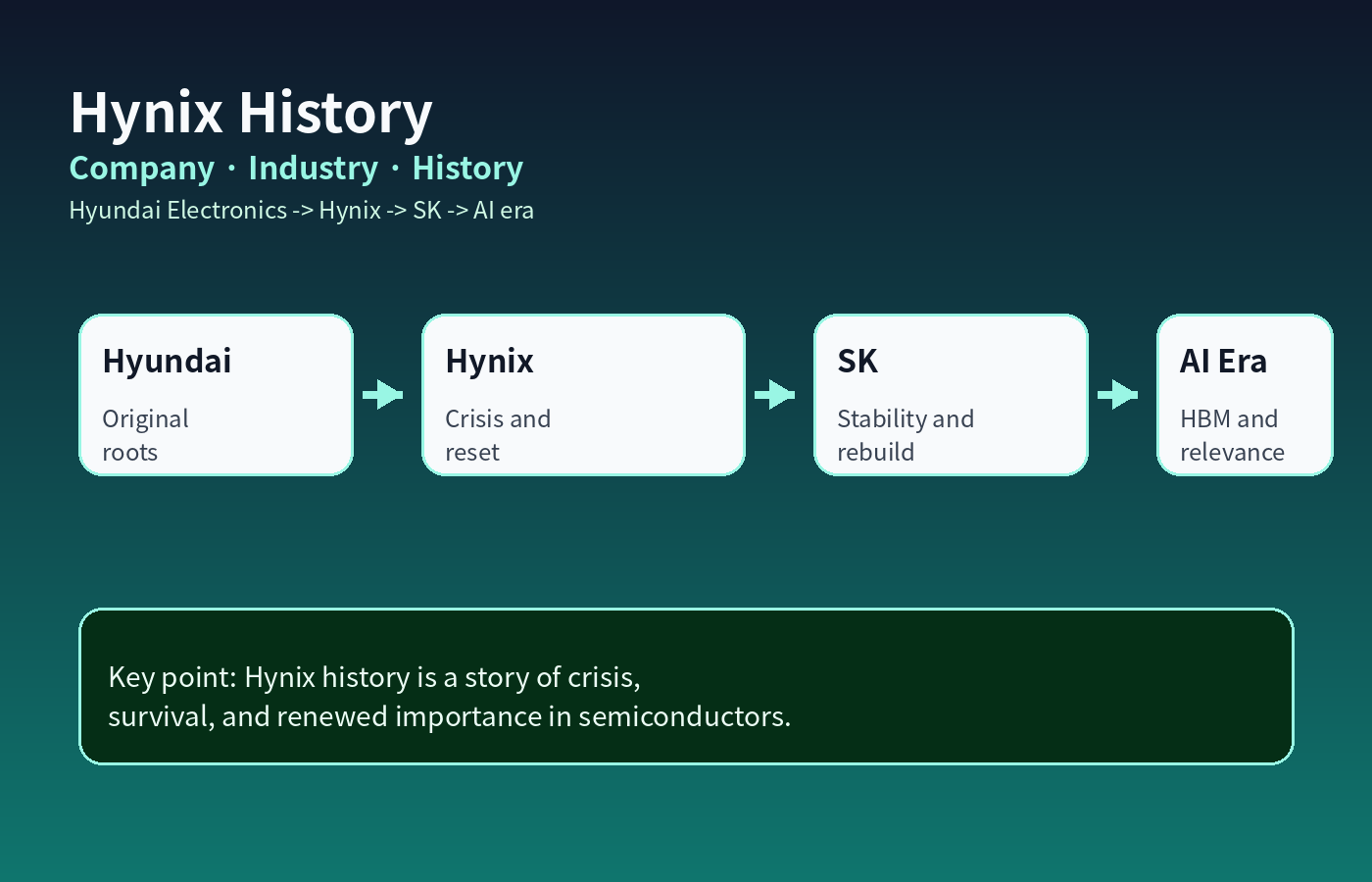
Today, SK hynix is widely recognized as one of Korea’s key semiconductor companies. But its history is far more dramatic than many people realize. Its story includes industrial ambition, financial stress, restructuring, survival, and eventually a return to global relevance in the AI era.
That makes Hynix interesting not only as a company, but also as a window into Korea’s semiconductor development. Its path reflects bigger themes such as industrial policy, market cycles, crisis management, and corporate reinvention.
It started as Hyundai Electronics
The roots of Hynix go back to Hyundai Electronics. During Korea’s industrial expansion, semiconductors were viewed as a strategic and difficult field that required large capital investment and long-term planning. Entering this industry was not easy, but the company invested heavily because memory chips were seen as a future growth engine.
This matters because it shows that the company’s origins were tied to an ambitious phase of Korean industrial growth. From the beginning, semiconductors were not treated as a side business — they were seen as a serious strategic sector.
Why the name changed
After the Asian financial crisis and the restructuring that followed, the company needed a new identity. That is part of how the name Hynix became important. It reflected not just a branding shift, but a reset during a difficult period in Korea’s corporate landscape.
In that sense, the name Hynix is closely tied to a survival-and-restructuring phase rather than a simple marketing decision. It symbolized a company trying to redefine itself under pressure.
A difficult survival phase
Hynix went through real hardship. Semiconductor cycles, debt pressure, restructuring, and weak market conditions created a period when the company’s future looked uncertain. That makes today’s image of SK hynix even more interesting: it was not always a comfortable success story.
This part of the history matters because many successful technology companies are often remembered only through their strongest periods. Hynix is different. Its modern identity makes more sense when readers understand how serious the crisis phase once was.
The SK turning point
One of the biggest turning points came when the company was brought into the SK Group. That gave it greater stability, stronger backing, and a clearer platform for long-term investment and global competition. It also helped shape the current identity of SK hynix.
This was important not only financially but symbolically. The transition helped shift the company from a story of survival toward a story of rebuilding and renewed strategic importance.
The AI era changed the story again
More recently, the company has become strongly associated with HBM and AI-related semiconductor demand. In other words, the story of Hynix has shifted from survival to renewed strategic importance.
That is a major change in narrative. A company once viewed through the lens of restructuring is now often discussed through growth, AI demand, and high-performance memory. This shift shows how technology cycles can reshape the meaning of a company over time.
Conclusion
The history of Hynix is not just a company timeline. It reflects a wider Korean semiconductor story: growth, crisis, restructuring, recovery, and re-emergence in a new technology cycle.
That is why Hynix history still matters today. It helps explain how the company became what it is now, and why its current relevance in AI-era semiconductors carries more weight than a simple short-term market trend.
If you want to see how this history connects to today’s market narrative, you can also read Why Is Hynix Back in the Spotlight? HBM, AI Chips, and Key Growth Drivers [eng].
For a broader Korean semiconductor comparison, see Samsung Electronics: Why It Still Stands at the Center of Korea’s Stock Market [eng].
Additional questions for investors
- Separate one-time product revenue from recurring or platform-style revenue.
- Ask what needs to happen before the current news can become visible earnings.
- Compare pricing power, customer base, technology position, and margin profile with competitors.
- Watch operating margin and free cash flow, not only headline revenue growth.
- Consider whether the stock price already reflects an optimistic scenario.
Public sources and editorial basis
This article is an explanatory guide based on publicly available materials such as company investor-relations pages, annual reports, quarterly earnings releases, official product or service announcements, and industry context. It is rewritten in plain language with emphasis on business model, revenue drivers, risks, and practical signals to watch. It is for education and information only, not a buy or sell recommendation.
Editorial basis and how to read this article
This article is based on publicly available company materials, filings, earnings releases, official announcements, market data, and news context. It is written as a plain-language explainer, not as a short-term price prediction. It is for education and information only and is not a buy or sell recommendation.
Reader checklist
- Check the date and source of key numbers.
- Compare headlines with actual earnings, filings, and market data.
- Look for both growth drivers and risks.
- Separate the business model from the stock narrative.
- Review the next earnings release or official update before making your own decision.