Why Hyundai Motor Is Getting Attention Again: EVs, Global Growth, and Key Business Drivers [eng]

Why Is Hyundai Motor Getting Attention Again?
A longer English overview of Hyundai Motor’s EV strategy, global production, premium branding, and industrial relevance.
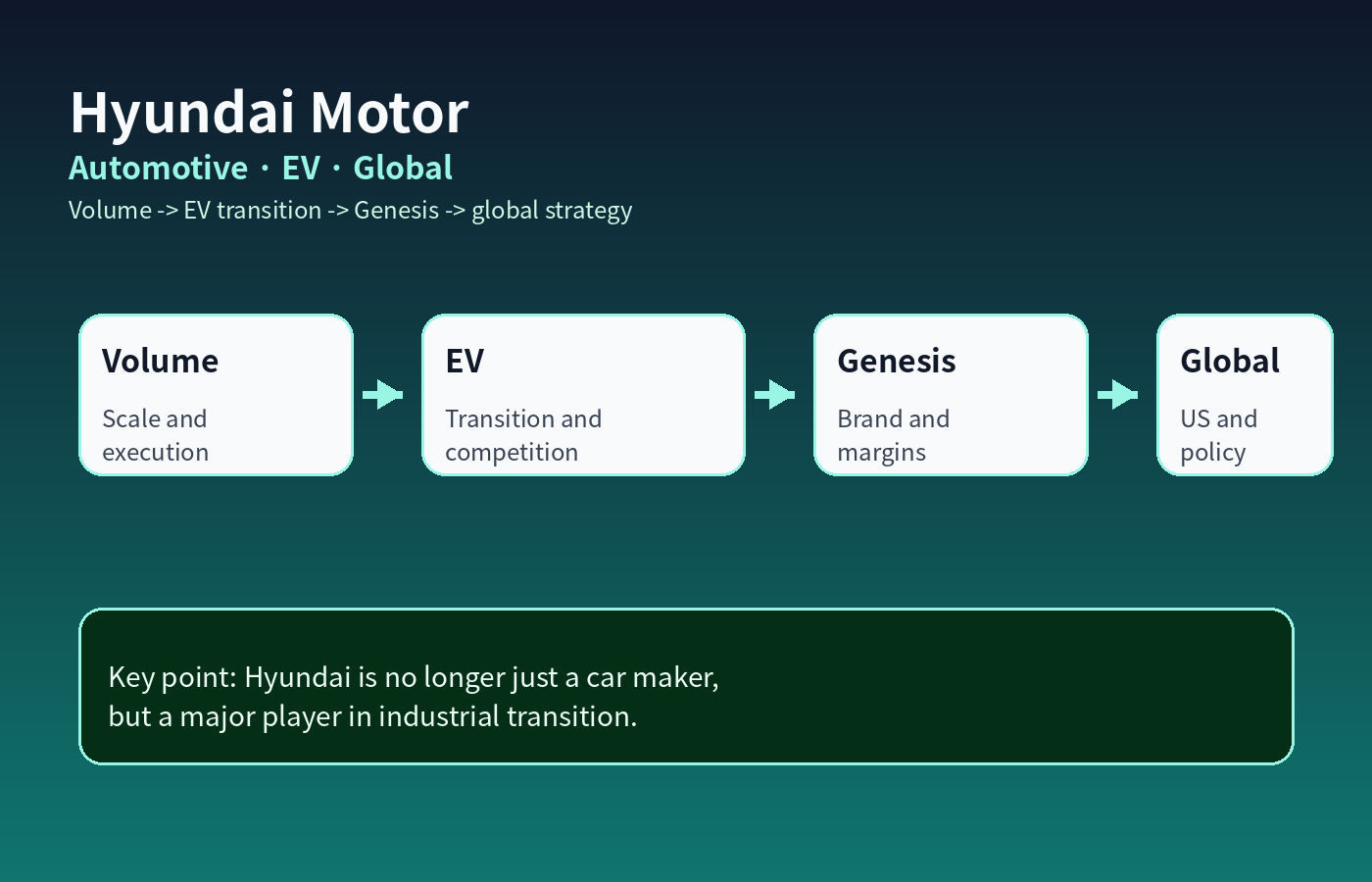
Hyundai Motor is no longer seen only as a domestic carmaker. It is now part of a much larger discussion about EVs, global manufacturing, premium branding, and industrial transition.
That matters because modern automakers are judged on much more than just unit sales. Investors and readers now look at how effectively a company can move from internal combustion to electrification, from pure manufacturing scale to global brand value, and from regional production to resilient international strategy.
Why Hyundai matters
Automotive companies are complex businesses. Production, supply chains, branding, distribution, and service all matter. Hyundai’s scale and global network make it more than just another cyclical stock story.
Its relevance comes from the fact that it combines mass-market manufacturing strength with broader strategic questions about industrial transition. Hyundai is not simply selling vehicles; it is navigating how a large manufacturing company stays competitive in an era of technological and regulatory change.
The EV transition is the key
In today’s market, electric vehicles are a major lens through which automakers are evaluated. Hyundai’s EV roadmap, platform strategy, and global positioning all influence how people view its future.
The EV transition matters because it is not only about replacing one powertrain with another. It affects supply chains, software, battery sourcing, policy support, and long-term margin structure. Hyundai’s ability to remain competitive in this shift will shape how the company is judged over time.
The US market and global production
The company’s role in the US market has become especially important because policy, local production, and incentives can all affect perception and growth prospects.
In other words, Hyundai’s story is not just about Korea anymore. It is about how a global automaker responds to local regulations, production requirements, and changing consumer demand across multiple regions. That gives the company a more international strategic profile than some readers may expect.
Genesis and brand value
Genesis matters because it can change how the market thinks about Hyundai’s pricing power and margins. That makes it relevant not only for image but also for profitability.
Premium branding can have a structural effect on how the market values an automaker. If Hyundai can strengthen the brand position of Genesis while also competing in EVs and mass-market segments, that gives it a more layered growth story than a simple volume-based narrative.
Conclusion
Hyundai is interesting not simply because it sells cars, but because it is trying to navigate one of the biggest industrial transitions in the modern auto sector.
That is why Hyundai deserves attention beyond standard automotive headlines. It sits at the intersection of electrification, global industrial strategy, policy exposure, and brand evolution — all of which matter in today’s market.
For another major Korean large-cap perspective, see Samsung Electronics: Why It Still Stands at the Center of Korea’s Stock Market [eng].
If you want a semiconductor-led AI angle, you can also read Why Nvidia Sits at the Center of the AI Era: GPUs, Data Centers, and Growth Drivers [eng].
Beginner questions investors often ask
Is Hyundai Motor only an EV story? No. Hyundai Motor should be understood through internal combustion vehicles, hybrids, EVs, Genesis premium models, global production, and future mobility investments. EVs matter, but hybrids and profitable SUVs can be just as important for near-term earnings.
Why do investors care about mix? Selling more high-margin SUVs, premium Genesis vehicles, and hybrids can improve profitability even if total unit growth is not dramatic. Beginners should not look only at vehicle volume; they should also check pricing, incentives, and product mix.
What is the main risk? Autos are cyclical. Demand can weaken when interest rates are high or consumers delay purchases. EV competition, battery costs, tariffs, recalls, labor costs, and currency movements can also affect earnings.
Business model in plain English
Hyundai earns money by designing, manufacturing, and selling vehicles through global markets. It also earns through financing, parts, after-sales service, and connected-car services. The company’s investment story depends on whether it can protect margins while shifting toward hybrids, EVs, software-defined vehicles, and global production flexibility.
What to watch next
- Hybrid and EV sales mix by region
- Genesis and SUV contribution to margins
- U.S., Korea, Europe, and India demand trends
- Incentive levels and inventory conditions
- Battery costs, tariffs, currency, and labor negotiations
Public sources used
This explainer is based on Hyundai Motor IR materials, earnings releases, annual reports, and official product/strategy announcements. For a Korean overview, see Hyundai Motor Korean explainer.
How to read Hyundai Motor earnings step by step
Start with product mix. Hyundai’s profit can improve when SUVs, Genesis premium models, and hybrids represent a larger share of sales. Unit volume matters, but margin per vehicle often matters more for earnings quality.
Second, check regional performance. The United States, Korea, Europe, and India can each move differently depending on consumer demand, incentives, currency, and local competition. A strong global footprint helps, but it also exposes Hyundai to multiple macro variables.
Third, watch the transition strategy. EVs are important, but hybrids, software-defined vehicles, battery sourcing, and manufacturing flexibility may matter just as much in the medium term. The investment question is whether Hyundai can manage the transition without sacrificing profitability.
Editorial basis and investment caution
This article is an educational explainer based on publicly available company and industry materials. It is not a buy or sell recommendation and does not promise any investment outcome. Before making decisions, readers should review the latest earnings releases, filings, company disclosures, market conditions, and their own risk tolerance.
Editorial basis and how to read this article
This article is based on publicly available company materials, filings, earnings releases, official announcements, market data, and news context. It is written as a plain-language explainer, not as a short-term price prediction. It is for education and information only and is not a buy or sell recommendation.
Reader checklist
- Check the date and source of key numbers.
- Compare headlines with actual earnings, filings, and market data.
- Look for both growth drivers and risks.
- Separate the business model from the stock narrative.
- Review the next earnings release or official update before making your own decision.