Why Does Dongwha Pharm Still Feel Familiar? Brand Power, Products, and Industry Trends [eng]

Why Does Dongwha Pharm Still Feel Familiar? Brand Power, Products, and Industry Trends [eng]
An English company-analysis version covering Whal Myung Su, business structure, competitors, strengths, risks, valuation checkpoints, and the shift toward consumer healthcare and dermacosmetics.
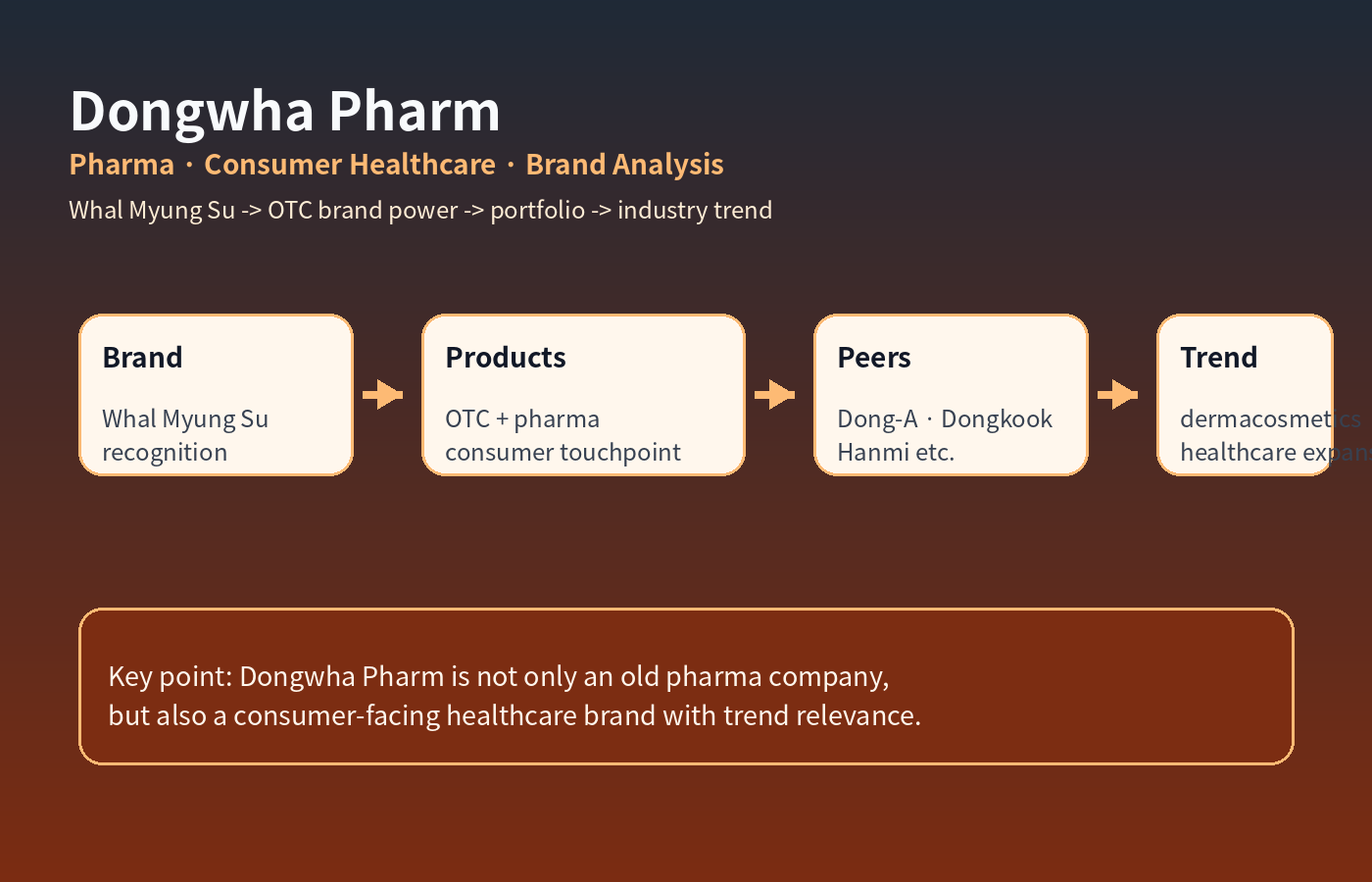
- Dongwha Pharm stands out because it combines a long pharmaceutical history with a highly familiar consumer-facing brand.
- The key point is not just tradition, but whether that brand power can connect to broader healthcare and lifestyle trends.
- Readers should look at products, competitors, business expansion, and the shift toward consumer healthcare, dermacosmetics, and health-related daily products.
One-line summary and company overview
Dongwha Pharm is one of the most recognizable pharmaceutical names in Korea. For many consumers, the company feels familiar because of Whal Myung Su, a long-standing digestive product that became closely linked with the company’s identity. That level of public recognition is not something every pharmaceutical company enjoys.
A useful one-line summary would be this: Dongwha Pharm is a pharmaceutical company with unusually strong consumer familiarity, built on history, OTC brand power, and broader healthcare relevance. That is what makes the company interesting not only as a traditional pharma name, but also as a consumer-facing healthcare brand.
Business structure and key products
The most symbolic product connected to Dongwha Pharm is Whal Myung Su. It is more than a single legacy product. It acts as a brand bridge between the company and ordinary consumers. In the pharmaceutical industry, that kind of direct consumer recognition is valuable because many companies are known more inside the medical system than in everyday life.
Still, Dongwha Pharm should not be read only as “the Whal Myung Su company.” A more complete analysis should look at the mix between OTC products, pharmaceutical operations, consumer healthcare exposure, and how the company may build beyond its historical image. In other words, the brand matters—but the structure behind the brand matters just as much.
- Whal Myung Su — the strongest symbol of the company’s public identity
- OTC product exposure — important because it keeps Dongwha close to consumers
- Pharmaceutical business base — still central to how the company should be understood
- Healthcare lifestyle expansion potential — increasingly relevant in today’s market
Competitor comparison
To understand Dongwha Pharm better, it helps to compare it with other Korean pharmaceutical companies such as Dong-A, Dongkook, Hanmi, and larger established names like Yuhan, Chong Kun Dang, or Daewoong depending on the angle of comparison.
- Dongwha Pharm — stronger consumer familiarity and legacy brand symbolism
- Dong-A / Dongkook — useful comparisons when discussing healthcare, consumer-facing extensions, or adjacent categories
- Hanmi — often viewed more through growth, pipeline, and innovation expectations
- Yuhan / Chong Kun Dang / Daewoong — important when comparing scale, market position, and broader pharmaceutical competitiveness
Dongwha’s difference is that its identity feels less purely institutional and more publicly familiar. That does not automatically make it stronger than peers, but it does give it a different strategic flavor.
Strengths
- Strong brand recognition — Whal Myung Su gives the company unusual familiarity for a pharma name
- Consumer touchpoint — OTC and consumer-facing products create direct public contact
- Historical trust — longevity can translate into brand confidence and recognition
- Expansion potential — a company with public brand familiarity may have more options in adjacent healthcare categories
These strengths matter because healthcare companies increasingly benefit from being understood not only as manufacturers or prescription suppliers, but also as trusted consumer-facing brands.
Weaknesses and risks
- Legacy-brand concentration — if the public image is too closely tied to one historic product, broader growth may look less visible
- Growth expectation gap — the market may assign higher premiums to companies with stronger pipeline or innovation narratives
- Competition — Korean pharma remains competitive across OTC, prescription, health-functional, and consumer-health categories
- Regulatory exposure — like other healthcare businesses, regulatory and policy variables remain relevant
So Dongwha Pharm may feel familiar and stable, but investors and readers still need to ask how much of its relevance is brand memory and how much comes from current business momentum.
Financial and valuation checkpoints
When looking at Dongwha Pharm, readers should not stop at brand image. The bigger questions are whether revenue is growing steadily, whether operating profit is stable, and whether the company is building a stronger mix beyond legacy recognition.
- Revenue — useful for seeing whether the company is maintaining or expanding its business base
- Operating profit — important for understanding the quality and stability of earnings
- Margins — helpful when evaluating product mix and business efficiency
- PER — should be read in the context of whether the company is viewed as a stable brand name or a growth story
- Business mix — especially important for judging whether OTC identity is broadening into stronger healthcare categories
In other words, brand familiarity is the opening point, but financial interpretation should focus on whether that familiarity translates into durable earnings and meaningful expansion potential.
Current industry trend and Dongwha Pharm’s position
One of the most important trends in healthcare today is that pharmaceutical companies are no longer judged only by prescription drugs or traditional OTC products. More and more companies are moving into consumer healthcare, dermacosmetics, functional beauty, health-related lifestyle products, and wellness-oriented daily categories.
This is exactly why companies like Dong-A, Dongwha, Dongkook, and Hanmi are often discussed in broader terms than before. The market increasingly asks not only what medicines a company sells, but also whether it can expand into products that consumers meet in everyday life. In that environment, Dongwha Pharm has an interesting advantage: it already has a name that many consumers recognize.
That does not automatically mean success in dermacosmetics or adjacent categories, but it does mean Dongwha starts from a stronger public-recognition base than many purely institutional pharmaceutical companies. So the key trend question becomes this: Can Dongwha Pharm turn legacy brand trust into broader consumer-healthcare relevance?
Conclusion
Dongwha Pharm still feels familiar not just because it is old, but because it has one of the rare pharmaceutical identities that ordinary consumers can recognize immediately. That gives the company a useful mix of history, trust, and consumer-facing relevance.
To understand Dongwha Pharm properly, readers should look at brand power, OTC identity, competitor positioning, financial stability, and the current shift toward consumer healthcare and dermacosmetic-style expansion together.
FAQ
Why is Dongwha Pharm so familiar to Korean consumers?
The biggest reason is Whal Myung Su, which has long served as the company’s most recognizable public-facing product.
Is Dongwha Pharm only about one famous legacy product?
No. That product is important symbolically, but the company should also be understood through its broader pharmaceutical and consumer-healthcare positioning.
What should readers watch first when analyzing Dongwha Pharm?
Revenue, operating profit, margins, product mix, and whether the company can translate brand familiarity into broader healthcare relevance are strong starting points.
For the Korean version, see 동화약품, 왜 아직도 익숙한 이름일까? 활명수부터 제약사업까지 흐름 정리.
For another brand-and-consumer-tech comparison, read Why Apple Remains One of the Strongest Brands in the World: iPhone, Services, and AI Strategy [eng].
Additional questions for investors
- Separate one-time product revenue from recurring or platform-style revenue.
- Ask what needs to happen before the current news can become visible earnings.
- Compare pricing power, customer base, technology position, and margin profile with competitors.
- Watch operating margin and free cash flow, not only headline revenue growth.
- Consider whether the stock price already reflects an optimistic scenario.
Public sources and editorial basis
This article is an explanatory guide based on publicly available materials such as company investor-relations pages, annual reports, quarterly earnings releases, official product or service announcements, and industry context. It is rewritten in plain language with emphasis on business model, revenue drivers, risks, and practical signals to watch. It is for education and information only, not a buy or sell recommendation.
Editorial basis and how to read this article
This article is based on publicly available company materials, filings, earnings releases, official announcements, market data, and news context. It is written as a plain-language explainer, not as a short-term price prediction. It is for education and information only and is not a buy or sell recommendation.
Reader checklist
- Check the date and source of key numbers.
- Compare headlines with actual earnings, filings, and market data.
- Look for both growth drivers and risks.
- Separate the business model from the stock narrative.
- Review the next earnings release or official update before making your own decision.