Why IBM Fell Again: AI, Hybrid Cloud, and the Recent Stock Drop Explained [eng]

Why IBM Fell Again: AI, Hybrid Cloud, and the Recent Stock Drop Explained [eng]
A company-analysis guide to IBM’s business model, Red Hat, enterprise AI, hybrid cloud strategy, mainframe cycle, and the recent stock selloff.
- IBM is no longer just an old computer company. It is now centered on enterprise software, hybrid cloud, AI, consulting, and mainframe infrastructure.
- The recent selloff was driven less by panic and more by weaker-than-expected software and infrastructure trends, delayed large deals, and pressure around the mainframe cycle.
- For investors, the key checkpoints are Red Hat growth, AI-related consulting demand, mainframe timing, free cash flow, and dividend sustainability.
One-line summary and overview
IBM is one of the most iconic technology companies in the United States. In the past, many people associated IBM with mainframes, enterprise computers, and traditional IT hardware. Today, however, IBM is a very different company. The main keywords are enterprise software, hybrid cloud, AI, consulting, and mission-critical infrastructure.
In one sentence, IBM can be described as “a technology company that helps large enterprises and governments modernize complex IT systems through AI and hybrid cloud.” It may not be as visible to consumers as Apple, Nvidia, or Google, but inside banks, governments, insurers, and global enterprises, IBM still plays an important role.
Why did IBM’s stock fall sharply?
The recent IBM stock drop should not automatically be interpreted as a sign that the entire company is broken. However, the reason for market disappointment is clear. IBM released selected preliminary second-quarter 2026 results, and several important areas came in below what investors had hoped to see.
IBM reported preliminary second-quarter revenue of $17.2 billion, up 1% year over year. On the surface, that is still growth. But the details were weaker: software revenue rose 5%, consulting was roughly flat, and infrastructure revenue declined 7%. Because the market has been valuing IBM as an AI and software transformation story, weaker software and infrastructure momentum caused a sharp reset in sentiment.
Management also explained that the z17 mainframe cycle and the related software stack did not perform as strongly as expected during the quarter. Several large deals also failed to close on the timeline IBM had anticipated. In addition, some clients shifted capital spending toward servers, storage, and memory purchases, which affected buying patterns for IBM’s own infrastructure and related software.
So the issue is not simply “IBM failed at AI.” A better interpretation is that IBM had AI and hybrid-cloud expectations embedded in its stock price, but the quarterly details did not support those expectations strongly enough. Based on available recent price data, it is also more accurate to describe the move as a sharp decline toward the lower end of the 52-week range rather than claiming an all-time low.
Business structure
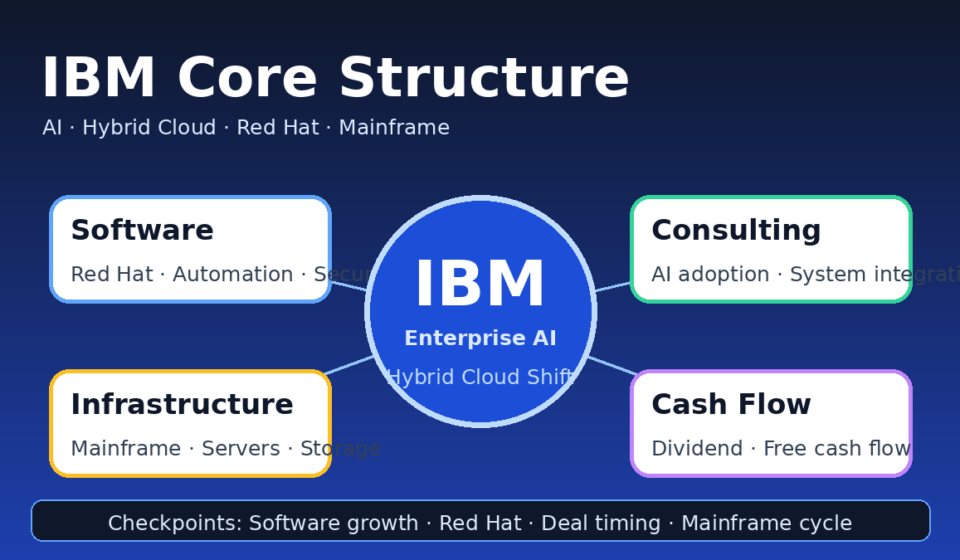
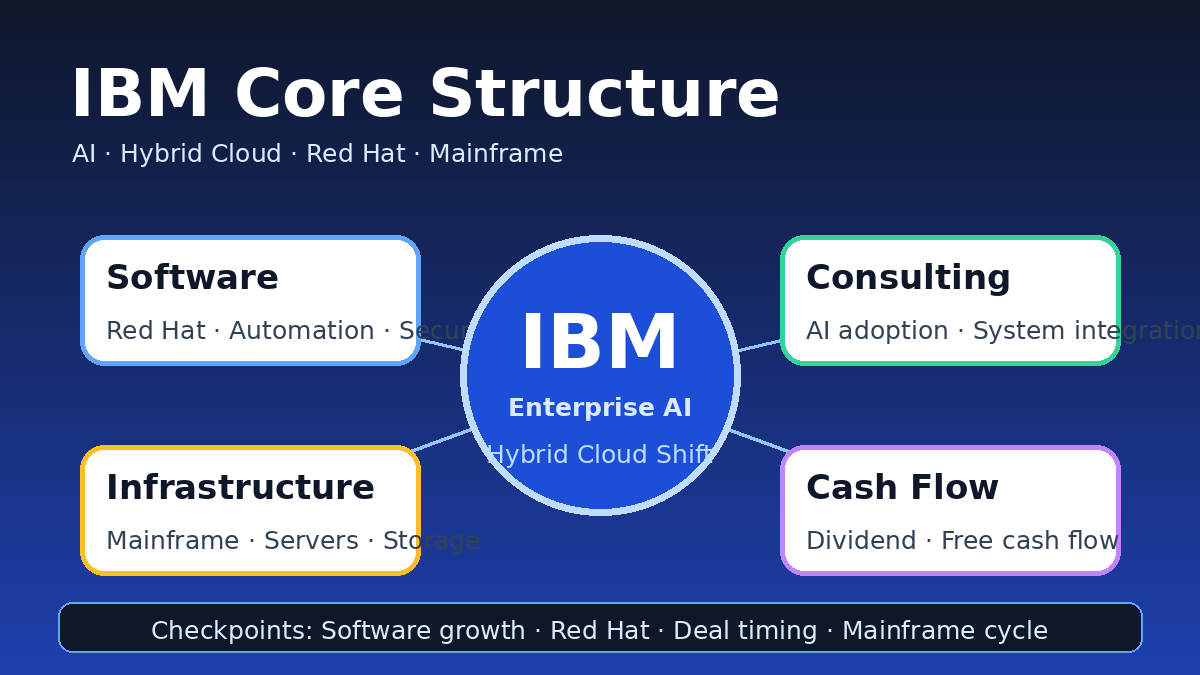
IBM’s business can be divided into software, consulting, infrastructure, and financing. Among these, software is the most important area for the company’s long-term re-rating. Software can produce recurring revenue and higher margins, which is why investors focus heavily on this segment.
Software includes Red Hat, automation, data, security, and AI-related platforms. Red Hat is especially important because it is the foundation of IBM’s hybrid cloud strategy. Large companies rarely move everything into a single public cloud. They often use a mix of private data centers, multiple public clouds, and regulated systems. Red Hat OpenShift and related technologies help IBM serve that complex environment.
Consulting helps enterprise customers actually implement technology. Many companies want to use AI, but connecting AI tools to internal systems, data, compliance, and workflows is difficult. IBM Consulting targets this problem through cloud migration, automation, cybersecurity, and enterprise AI projects.
Infrastructure includes mainframes, servers, and storage. Mainframes may sound old, but they remain important in banking, insurance, government, and other industries that require reliability and security. The downside is that infrastructure revenue can fluctuate depending on product cycles and customer spending timing.
AI and hybrid cloud strategy
IBM’s AI strategy is different from Nvidia, OpenAI, or consumer-facing AI platforms. IBM focuses on enterprise AI: AI that can be used inside regulated, complex, and mission-critical business environments. That means security, governance, compliance, data integration, and workflow automation matter as much as the model itself.
Hybrid cloud is also central to IBM’s strategy. Instead of assuming every company will move everything to one cloud provider, IBM focuses on helping clients run workloads across private infrastructure, public clouds, and legacy systems. This is where Red Hat becomes strategically important.
The positive side is that Red Hat revenue growth accelerated sequentially in IBM’s preliminary update. The negative side is that overall software growth was not strong enough to satisfy investors. For IBM’s AI story to work, AI must not remain a slogan. It has to show up in software revenue, consulting signings, margins, and free cash flow.
Competitor comparison
IBM’s competitors vary by business line. In cloud infrastructure, it competes indirectly with Amazon AWS, Microsoft Azure, and Google Cloud. However, IBM is not trying to win the same scale race as those hyperscalers. It is more focused on hybrid environments, regulated industries, and complex enterprise systems.
- Microsoft — a strong competitor in Azure, enterprise software, and AI copilots
- Amazon AWS — the leader in cloud infrastructure scale and developer adoption
- Google Cloud — strong in AI, data analytics, and cloud-native technology
- Oracle — a major player in databases, enterprise software, and cloud infrastructure
- Accenture — a key comparison point in consulting and digital transformation projects
IBM’s differentiation comes from its long-standing enterprise relationships, Red Hat, mainframe installed base, and experience with complex regulated systems. In other words, IBM is not the flashiest AI stock. It is more of a deeply embedded enterprise IT company trying to modernize its role in the AI era.
Strengths
IBM’s first strength is its enterprise customer base. Large banks, governments, insurers, and multinational corporations do not replace core IT systems easily. IBM has long-standing relationships with these customers, which creates a meaningful barrier to entry.
The second strength is Red Hat. Red Hat is the asset that prevents IBM from being viewed only as a legacy technology company. As hybrid cloud, containers, and open-source infrastructure remain important, Red Hat can continue to support IBM’s strategic relevance.
The third strength is cash flow and dividends. IBM is not a pure hypergrowth stock. It is often evaluated as a mix of technology transformation, enterprise software, and income-oriented stability. That makes free cash flow an important part of the investment case.
Weaknesses and risks
The biggest risk is growth speed. IBM is connected to AI and cloud, but it does not grow like Nvidia. When market expectations become high, even a small disappointment in the details can cause a large stock reaction.
The second risk is business complexity. Software, consulting, and infrastructure all have different growth rates and margin profiles. Strength in one area can be offset by weakness in another, making the overall story harder to read.
The third risk is competition. Microsoft, Amazon, Google, Oracle, and Accenture are all strong in areas where IBM wants to grow. IBM must prove that enterprise AI and hybrid cloud are not just marketing themes but real revenue and profit drivers.
Financial and valuation checkpoints
For IBM, investors should not look only at total revenue growth. The first key metric is software revenue growth, because software is central to IBM’s re-rating story. Red Hat growth is especially important because it signals whether IBM’s hybrid cloud platform remains competitive.
The second checkpoint is consulting signings and AI-related projects. Generative AI adoption in enterprises often requires consulting, system integration, governance, and workflow redesign. IBM needs to show that AI demand is turning into real contracts.
The third checkpoint is the mainframe and infrastructure cycle. Mainframes remain important, but revenue can be uneven depending on product timing and customer budget cycles. The recent selloff showed how sensitive investors can be to this segment.
The final checkpoint is free cash flow and dividend coverage. IBM’s valuation depends not only on growth but also on whether it can keep generating enough cash to support investment, acquisitions, debt management, and dividends.
Conclusion
IBM is not simply an old computer company anymore. It is trying to redefine itself around enterprise AI, hybrid cloud, Red Hat, consulting, and mission-critical infrastructure. But the recent stock drop shows that the market will not accept that transformation story on words alone. IBM has to prove it in the numbers.
The selloff does not necessarily mean IBM’s long-term strategy has failed. A more balanced interpretation is that expectations had risen, and the preliminary quarterly details were not strong enough to support those expectations. The next important areas to watch are software growth, Red Hat momentum, consulting demand, deal timing, and the mainframe cycle.
In short, IBM is not a flashy AI infrastructure winner like Nvidia. But it remains relevant in the slower, deeper enterprise AI transition. For investors, the key question is whether the recent weakness is only a timing issue around large deals and mainframe demand, or an early warning that IBM’s growth story is losing momentum.
For AI infrastructure, see Why Nvidia Sits at the Center of the AI Era.
For cloud and big tech context, see Amazon and Alphabet.
※ This article is for educational company analysis only and is not investment advice.
Additional questions for investors
- Separate one-time product revenue from recurring or platform-style revenue.
- Ask what needs to happen before the current news can become visible earnings.
- Compare pricing power, customer base, technology position, and margin profile with competitors.
- Watch operating margin and free cash flow, not only headline revenue growth.
- Consider whether the stock price already reflects an optimistic scenario.
Public sources and editorial basis
This article is an explanatory guide based on publicly available materials such as company investor-relations pages, annual reports, quarterly earnings releases, official product or service announcements, and industry context. It is rewritten in plain language with emphasis on business model, revenue drivers, risks, and practical signals to watch. It is for education and information only, not a buy or sell recommendation.
Editorial basis and how to read this article
This article is based on publicly available company materials, filings, earnings releases, official announcements, market data, and news context. It is written as a plain-language explainer, not as a short-term price prediction. It is for education and information only and is not a buy or sell recommendation.
Reader checklist
- Check the date and source of key numbers.
- Compare headlines with actual earnings, filings, and market data.
- Look for both growth drivers and risks.
- Separate the business model from the stock narrative.
- Review the next earnings release or official update before making your own decision.