What Kind of Company Was SanDisk, and Why Is It Getting Attention Again? Storage Trends and Key Market Points [eng]

What Kind of Company Was SanDisk, and Why Is It Getting Attention Again?
An English company-analysis version covering storage history, key products, competitors, strengths, risks, and today’s market relevance.
- SanDisk became widely known because it helped define the consumer flash-storage era through memory cards, USB drives, and SSD-related products.
- Its relevance today comes from the broader importance of digital storage, NAND flash, and data growth, not just from nostalgia around an old brand.
- Readers should understand SanDisk through brand history, product categories, competition, and the long-term trend toward more data creation and storage demand.
One-line summary and company overview
SanDisk is one of the most recognizable names in consumer digital storage. For many people, the brand is associated with memory cards, USB flash drives, and portable storage devices that became essential during the rise of digital cameras, smartphones, and personal media use. Because of that, SanDisk carries both technological relevance and strong brand recognition.
A useful one-line summary would be this: SanDisk was one of the defining storage brands of the flash-memory era, and its name still matters because storage demand never really disappeared—it evolved. That is why the company or brand continues to draw attention whenever people talk about NAND flash, portable storage, or the broader storage ecosystem.
Business structure and historical role
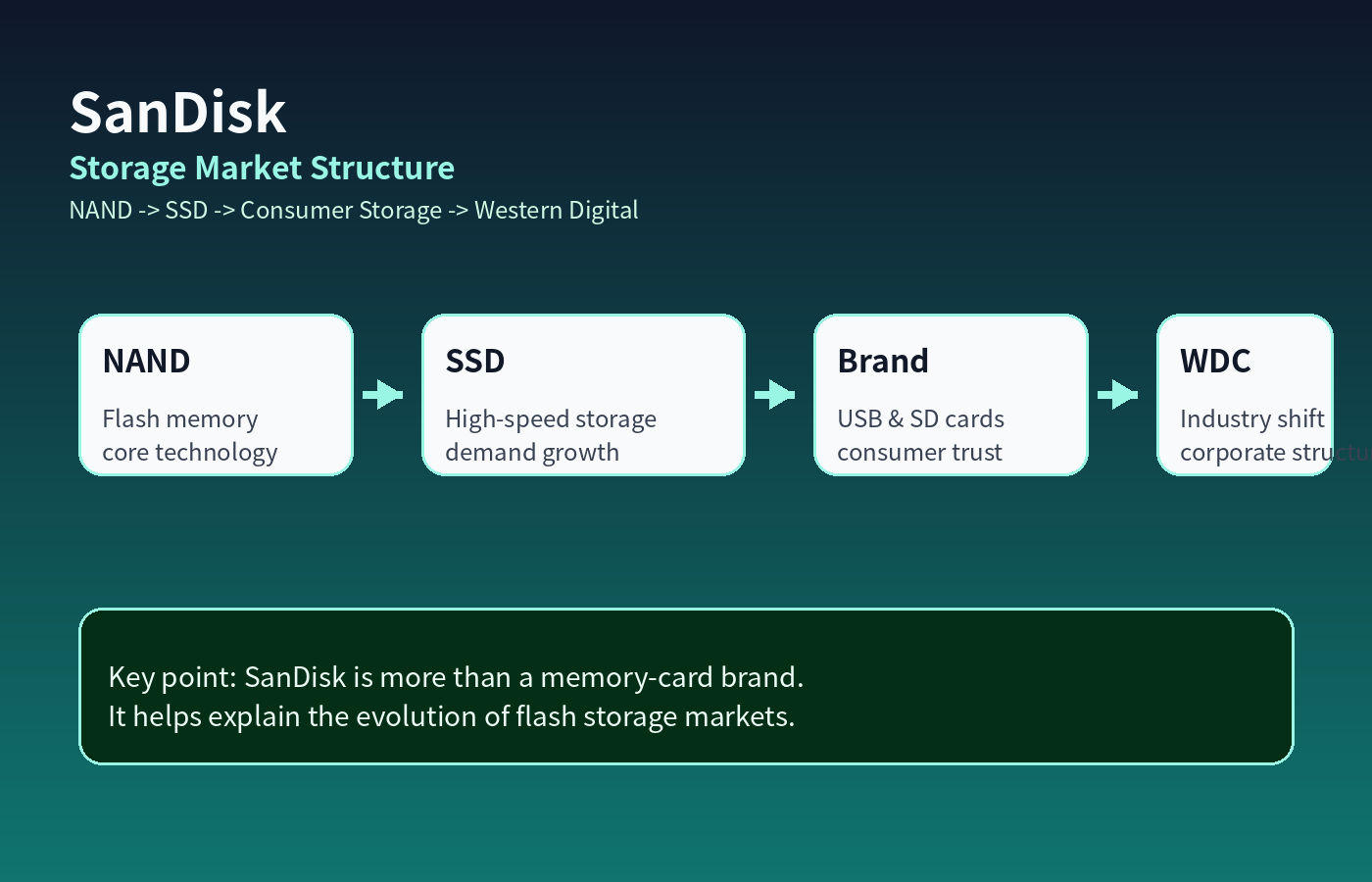
SanDisk was important because it operated at the intersection of consumer technology and flash storage. It helped bring flash memory into everyday life through practical products that ordinary users understood immediately. Unlike infrastructure-heavy semiconductor names that many consumers barely recognize, SanDisk became visible because people actually held and used its products.
Its historical role matters because it connected a deep technology trend—flash storage—with mass-market consumer adoption. In other words, SanDisk was not just part of storage history; it helped make storage technology feel tangible to ordinary users.
Key products and why they mattered
The most familiar SanDisk products were memory cards, USB flash drives, microSD cards, and other portable storage tools. These products became important as digital cameras, smartphones, gaming devices, and personal media storage all expanded. In later discussions, SSD-related relevance also became part of the broader storage narrative.
- Memory cards — central to cameras, mobile devices, and consumer digital storage
- USB flash drives — one of the most familiar portable storage products for everyday users
- microSD and removable storage — tied to mobile-device expansion and embedded storage needs
- SSD-related positioning — important in the broader shift toward faster digital storage
What made these products important was not only the technology inside them, but the fact that they became part of daily digital behavior. SanDisk was a brand many consumers encountered directly, not just a supplier hidden deep in the supply chain.
Competitor comparison
SanDisk should be understood against both consumer-facing storage brands and deeper memory-industry players. In consumer perception, competition often came from storage brands offering similar removable or portable products. In the broader industry context, NAND flash competition and manufacturing scale brought companies like Samsung, Micron, Kioxia, and Western Digital into the picture depending on the period and business structure being discussed.
- Samsung — major comparison in storage products, NAND strength, and broader electronics scale
- Micron — important memory-industry comparison from a semiconductor perspective
- Kioxia — relevant in NAND flash conversations
- Western Digital — significant when discussing the storage market and brand/business integration
SanDisk’s difference was that it combined technology relevance with a strong consumer-facing identity. Many memory companies were important, but fewer became household names in the same way.
Strengths
- Strong brand recognition — many consumers knew the brand directly from everyday storage use
- Clear product usefulness — its products solved practical problems people understood immediately
- Flash-memory relevance — closely tied to one of the most important shifts in modern storage
- Consumer and technology crossover — stood at a rare point between semiconductor trends and daily consumer behavior
These strengths explain why SanDisk still feels familiar to many readers even years after the flash-storage market became more mature and more complex.
Weaknesses and risks
- Commoditization pressure — many storage products eventually face price competition and thinner differentiation
- Technology shifts — removable storage trends can change as devices evolve
- Memory-cycle exposure — broader NAND and storage economics can create volatility
- Brand nostalgia risk — readers sometimes remember the brand more clearly than they understand its current strategic context
That last point matters. A familiar brand can attract attention, but investors and readers should still ask whether the current business relevance is driven by real market demand, strong positioning, and product economics—not just old recognition.
Financial and valuation checkpoints
When discussing a storage company or storage-related brand like SanDisk, the key financial questions are not only about revenue size. Readers should ask how well the company participates in higher-value storage categories and whether margins hold up in a competitive market.
- Revenue — useful for tracking whether demand is stable or tied too heavily to narrow product cycles
- Operating profit — shows whether storage demand is translating into real earnings power
- Margins — especially important in markets where commoditization pressure is strong
- PER — should be interpreted with storage-cycle context, not in isolation
- Product mix — readers should watch whether the business is exposed to low-margin categories or stronger premium segments
In storage-related businesses, valuation often depends on how investors judge the durability of demand, the quality of the product mix, and whether market attention is based on real earnings potential or just a temporary theme.
Current storage-industry trend and SanDisk’s relevance
The most important long-term trend is simple: the world keeps producing more data. Consumer devices, cloud services, photos, video, gaming, AI systems, and enterprise infrastructure all rely on storage in one form or another. That means storage demand has not disappeared—it has changed shape.
For SanDisk, this matters because the brand sits in a part of technology history that is still connected to the present. While the market now pays more attention to AI infrastructure, data centers, and high-performance memory, the underlying need to store, move, and manage data remains fundamental. In that sense, SanDisk still makes sense as part of the bigger digital-storage story.
Another important point is that storage is no longer just about removable media. It is increasingly connected to performance, speed, reliability, and integration across devices and systems. That means readers should view SanDisk not only as an old flash-card brand, but as part of a wider storage and memory ecosystem whose meaning keeps evolving.
Conclusion
SanDisk still gets attention because it represents more than a familiar old tech brand. It represents a crucial chapter in how flash storage became part of everyday digital life, and it remains relevant whenever the market revisits the broader question of how data is stored and used.
To understand SanDisk well, readers should look at brand history, product usefulness, competitor context, storage-industry economics, and the ongoing expansion of digital data demand together.
FAQ
Why do people still remember SanDisk so clearly?
Because it was one of the few storage brands that ordinary consumers interacted with directly through memory cards and USB drives.
Is SanDisk relevant only as an old brand?
No. Its continued relevance comes from the broader importance of flash storage, digital data growth, and storage technology’s ongoing role in modern computing.
What should readers watch first when analyzing a storage-related company?
Revenue quality, operating profit, margins, product mix, and how exposed the business is to commoditized versus higher-value storage categories.
For a Korean-language version of the storage story, see 샌디스크, 어떤 회사였고 지금은 왜 다시 주목받을까? 저장장치 시장 흐름 정리.
For the AI-era memory angle, read Why Is Hynix Back in the Spotlight? HBM, AI Chips, and Key Growth Drivers [eng].
Additional questions for investors
- Separate one-time product revenue from recurring or platform-style revenue.
- Ask what needs to happen before the current news can become visible earnings.
- Compare pricing power, customer base, technology position, and margin profile with competitors.
- Watch operating margin and free cash flow, not only headline revenue growth.
- Consider whether the stock price already reflects an optimistic scenario.
Public sources and editorial basis
This article is an explanatory guide based on publicly available materials such as company investor-relations pages, annual reports, quarterly earnings releases, official product or service announcements, and industry context. It is rewritten in plain language with emphasis on business model, revenue drivers, risks, and practical signals to watch. It is for education and information only, not a buy or sell recommendation.
Editorial basis and how to read this article
This article is based on publicly available company materials, filings, earnings releases, official announcements, market data, and news context. It is written as a plain-language explainer, not as a short-term price prediction. It is for education and information only and is not a buy or sell recommendation.
Reader checklist
- Check the date and source of key numbers.
- Compare headlines with actual earnings, filings, and market data.
- Look for both growth drivers and risks.
- Separate the business model from the stock narrative.
- Review the next earnings release or official update before making your own decision.