Doosan Explained: Nuclear Power, Robotics, and Holding Company Value

Doosan Explained: Nuclear Power, Robotics, and Holding Company Value
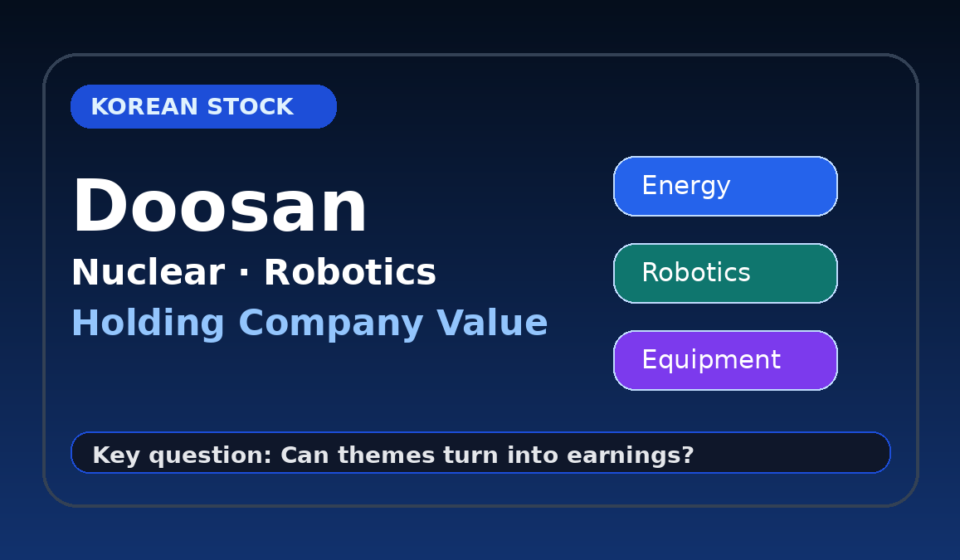
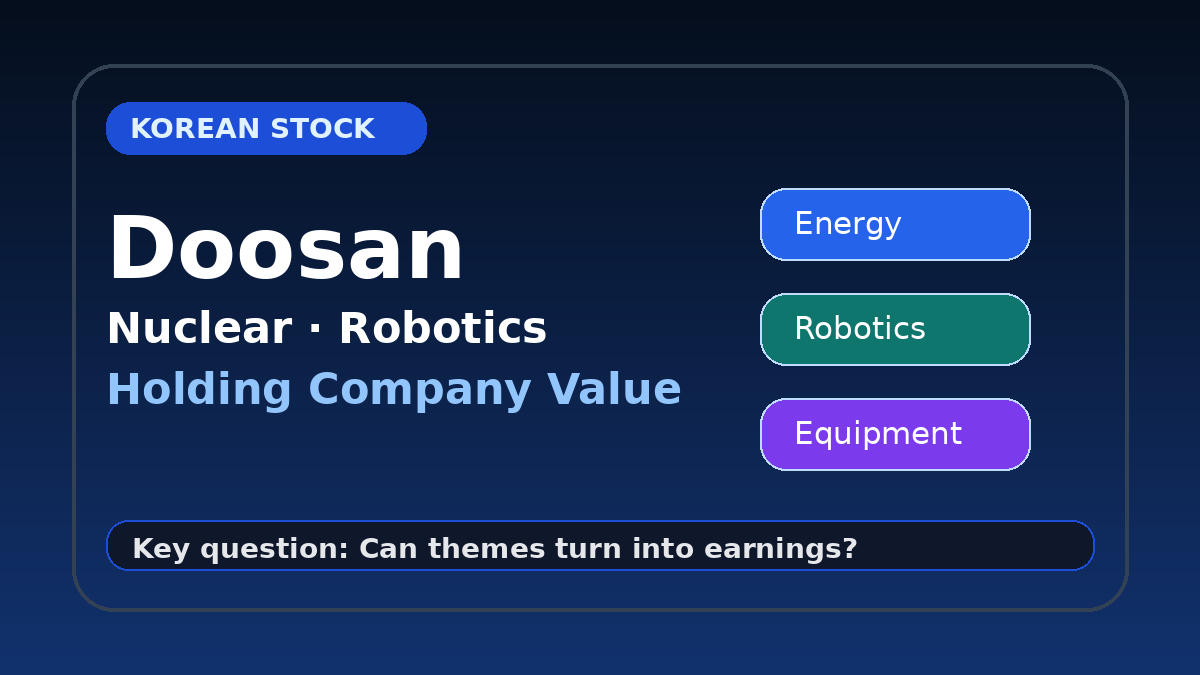
Doosan is not just an old Korean conglomerate name. Investors need to read it through holding-company value, energy infrastructure, robotics, industrial equipment, and semiconductor testing exposure.
- Doosan should be understood as a group-style investment story, not as one simple operating business.
- The market often connects Doosan with nuclear power, SMR, power infrastructure, collaborative robots, industrial equipment, hydrogen fuel cells, and semiconductor testing.
- Readers should separate Doosan Corporation from Doosan Enerbility, Doosan Robotics, Doosan Bobcat, Doosan Fuel Cell, and Doosan Tesna.
- Main risks include holding-company discount, subsidiary earnings cycles, robotics profitability, long project timelines in nuclear power, financial structure, and governance changes.
한국어 버전은 여기에서 볼 수 있습니다.
When people search for Doosan, they often see several themes at once: nuclear power, small modular reactors, robotics, Bobcat, fuel cells, and semiconductor testing. That can make the company confusing for first-time readers. The key is that Doosan is not one clean single-product company. It is better understood as a group-style investment story that combines Doosan Corporation’s own business, holding-company characteristics, and the value of major listed affiliates.
This article is not a buy or sell recommendation. It is a plain-English checklist for readers who want to understand which Doosan-related company they are actually looking at, how each theme connects to listed entities, and what signals should be checked next.
What is Doosan?
Doosan Corporation is the listed parent-style company of the Doosan Group. It has holding-company characteristics and also owns operating businesses, including electronic materials. That means its investment story is influenced not only by its own operating results, but also by subsidiary value, dividends, cash flow, financial structure, and possible group restructuring.
The broader Doosan Group includes Doosan Enerbility in energy and power infrastructure, Doosan Robotics in collaborative robots, Doosan Bobcat in compact construction equipment, Doosan Fuel Cell in hydrogen fuel cells, and Doosan Tesna in semiconductor testing services. Some of these are separately listed and have their own investment logic. So when someone says “Doosan is moving,” the first question should be: which Doosan company and which theme?
Why is Doosan being searched now?
Three themes explain much of the renewed attention. The first is nuclear power and power infrastructure. AI data centers, electricity demand, energy security, and decarbonization have brought nuclear power, SMR, gas turbines, and power-equipment suppliers back into the market conversation. This theme is most directly connected to Doosan Enerbility.
The second theme is robotics. Automation demand is rising not only in manufacturing, but also in logistics, food service, and other service settings. Doosan Robotics represents this growth angle, but investors still need to check whether revenue growth can translate into improving profitability.
The third theme is holding-company value. Doosan Corporation holds several affiliate interests and operating businesses. Its share price can therefore reflect affiliate stock prices, subsidiary earnings, dividends, financial leverage, and governance news. That makes Doosan more than a simple theme stock.
Business structure: own business and listed affiliates
A practical way to read Doosan is to separate the listed entities and their cycles. Doosan Corporation combines holding-company value and own operations, while Doosan Enerbility, Doosan Robotics, Doosan Bobcat, Doosan Fuel Cell, and Doosan Tesna each respond to different industry drivers.
- Doosan Corporation: holding-company value, own business, dividends, cash flow, and subsidiary valuation.
- Doosan Enerbility: nuclear power, SMR, power equipment, gas turbines, and energy infrastructure.
- Doosan Robotics: collaborative robots, service robots, automation demand, and path to profitability.
- Doosan Bobcat: compact construction equipment, North American construction/infrastructure demand, rates, and inventory cycle.
- Doosan Fuel Cell and Doosan Tesna: hydrogen policy, fuel-cell orders, semiconductor testing demand, and customer investment cycles.
These pillars do not move in the same way. Nuclear power is a long-cycle project and policy story. Robotics is a growth-and-profitability story. Bobcat is tied to construction demand and interest rates. Tesna is linked to the semiconductor cycle. Fuel Cell depends on policy support and order conversion. Investors should separate group-level excitement from affiliate-level numbers.
Growth points and positive catalysts
The attractive part of the Doosan story is that the group touches several long-term investment themes at once. Power infrastructure, nuclear energy, automation, industrial equipment, and semiconductor testing can all sound compelling when market attention rotates toward them.
- Nuclear and SMR expectations: rising electricity demand and energy security concerns can support interest in nuclear-related value chains.
- Power infrastructure in the AI era: data-center growth increases attention on power generation, turbines, grid-related equipment, and energy infrastructure.
- Collaborative robots: labor shortages, wage pressure, factory automation, and service automation can support long-term demand.
- Industrial-equipment cash flow: Doosan Bobcat can provide meaningful earnings contribution, although it remains cyclical.
- Semiconductor testing demand: Doosan Tesna can benefit when semiconductor investment and testing demand improve.
Risks and common misunderstandings
The biggest risk is that many attractive keywords can blur the actual investment case. Nuclear power, robotics, hydrogen, semiconductors, and construction equipment all sound powerful, but each has a different timeline, margin profile, and valuation framework.
- Holding-company discount: even if affiliate value rises, Doosan Corporation may trade at a discount to the value of its holdings.
- Robotics profitability: Doosan Robotics needs to prove not only growth, but also a clearer path toward sustainable earnings.
- Nuclear project timing: orders and policy expectations can take a long time to become revenue and profit.
- Affiliate cyclicality: Bobcat is sensitive to construction demand and rates, Tesna to semiconductors, and Fuel Cell to policy and orders.
- Financial and governance variables: restructuring, stake sales, leverage, dividends, and group governance can move investor sentiment.
Investor checklist
- Whether Doosan Corporation’s own business revenue and operating profit remain stable.
- Whether Doosan Enerbility’s nuclear, SMR, and power-infrastructure orders convert into revenue and margins.
- Whether Doosan Robotics shows revenue growth, narrowing losses, and a clearer recurring-sales structure.
- Whether Doosan Bobcat’s North American demand, inventory, and rate sensitivity remain manageable.
- Whether Doosan Tesna and Doosan Fuel Cell see better industry conditions, policy support, or order conversion.
- How the holding-company discount changes relative to subsidiary and affiliate value.
- Whether restructuring, dividends, debt, stake sales, or governance news changes the shareholder-value story.
Conclusion: Doosan should be checked by affiliate-level numbers, not only by themes
If you are looking at Doosan for the first time, the key misunderstanding to avoid is simple: Doosan is not just a nuclear stock, and it is not just a robotics stock. It is a group-style investment case where Doosan Corporation’s own business and the value of several listed affiliates overlap.
The core question is this: can expectations around nuclear power, power infrastructure, and robotics turn into real earnings, cash flow, and higher affiliate value? To answer that, investors should check Doosan Enerbility’s order conversion and margins, Doosan Robotics’ path to profitability, Doosan Bobcat’s cycle, and Doosan Corporation’s holding-company discount and financial structure.
In short, Doosan has several attractive themes, but the checklist needs to stay numerical. When the next Doosan headline appears, first ask which affiliate it affects, how it connects to Doosan Corporation shareholder value, and whether the expectation is visible in actual results.
For Korean manufacturing and electronics comparisons, see LG Electronics and Samsung Electronics.
For mobility and industrial demand, compare with Kia. For AI infrastructure and semiconductor context, see the memory semiconductor guide.
This article is for company and industry understanding only. It is not investment advice. Always check the latest filings, earnings releases, order data, and financial statements before making investment decisions.
Additional questions for investors
- Separate one-time product revenue from recurring or platform-style revenue.
- Ask what needs to happen before the current news can become visible earnings.
- Compare pricing power, customer base, technology position, and margin profile with competitors.
- Watch operating margin and free cash flow, not only headline revenue growth.
- Consider whether the stock price already reflects an optimistic scenario.
Public sources and editorial basis
This article is an explanatory guide based on publicly available materials such as company investor-relations pages, annual reports, quarterly earnings releases, official product or service announcements, and industry context. It is rewritten in plain language with emphasis on business model, revenue drivers, risks, and practical signals to watch. It is for education and information only, not a buy or sell recommendation.