Kia Explained: EVs, Hybrids, PBV, and the Real Investment Checklist Behind Korea’s Auto Giant

Kia Explained: EVs, Hybrids, PBV, and the Real Investment Checklist
Kia is not just another car brand inside Hyundai Motor Group. For investors, the story is about global sales mix, SUV/RV profitability, hybrid demand, electric vehicle execution, and whether PBV can become a real business line.
- Kia is a listed company in Korea, commonly tracked under ticker 000270.
- The business still depends on vehicle sales, but the investment question is about mix, margins, incentives, and transition cost.
- Hybrids and SUV/RV models can protect earnings while the EV market moves from rapid growth to more selective growth.
- The long-term upside case depends on EV3, EV4, EV9, and the PV5-led PBV strategy turning into sales and margins.
- Main risks include tariffs, FX volatility, EV price competition, quality costs, recalls, and consumer demand cycles.
1. What kind of company is Kia?
Kia is a global automaker and a major listed company within Hyundai Motor Group. It sells passenger cars, SUVs, RVs, electric vehicles, and commercial vehicles across Korea, North America, Europe, and other global markets.
The simplest description is that Kia makes and sells cars. But for investors, that is not enough. Auto company profits depend on where vehicles are sold, which models are selling, how much incentive is needed, what happens to FX rates, and whether quality costs appear in a given quarter.
One SUV with a strong option mix can contribute more profit than a low-margin compact model. That is why Kia should be analyzed through sales mix and profitability, not only headline unit sales.
2. Why Kia matters now
Kia is being watched because the auto transition is becoming more complicated. EV demand is still important, but the market has moved from a simple high-growth narrative into a more selective phase where price, battery cost, charging infrastructure, and subsidies matter.
At the same time, hybrids have become a practical bridge. If EV adoption slows, a strong hybrid lineup can protect earnings and help fund future investments. Kia also has a broader EV lineup, including EV3, EV4, and EV9, and is pushing into PBV, or purpose-built vehicles, through models such as PV5.
Kia’s official global positioning highlights EV, hybrid, and PBV as major mobility themes. For investors, the key is whether those themes translate into margin-accretive sales rather than just marketing language.
3. Business structure: volume is not enough
Internal combustion, hybrids, and EVs move together
Kia is not a pure EV company. Its earnings still come from a combination of internal-combustion vehicles, hybrids, and electric vehicles. This can look less exciting than a pure EV story, but it can also be an advantage when EV demand is uneven.
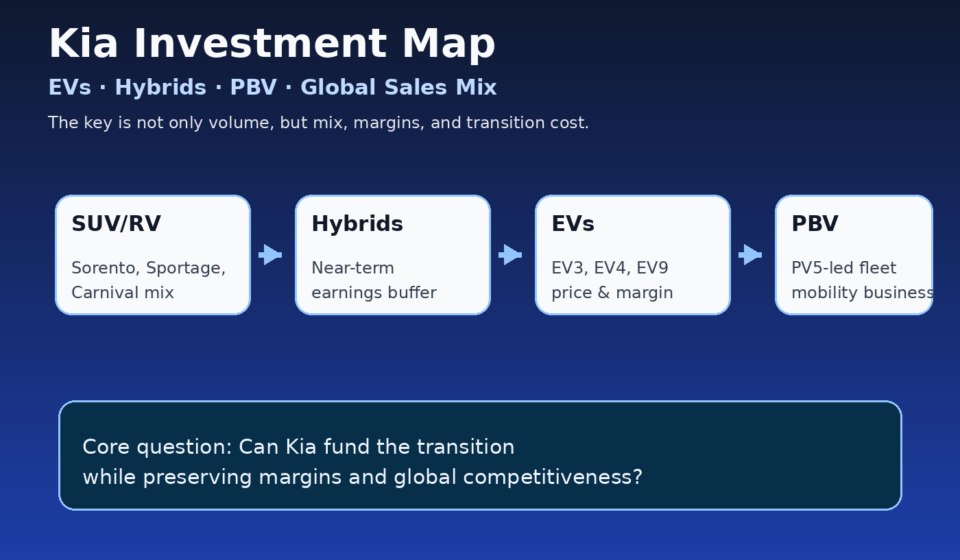
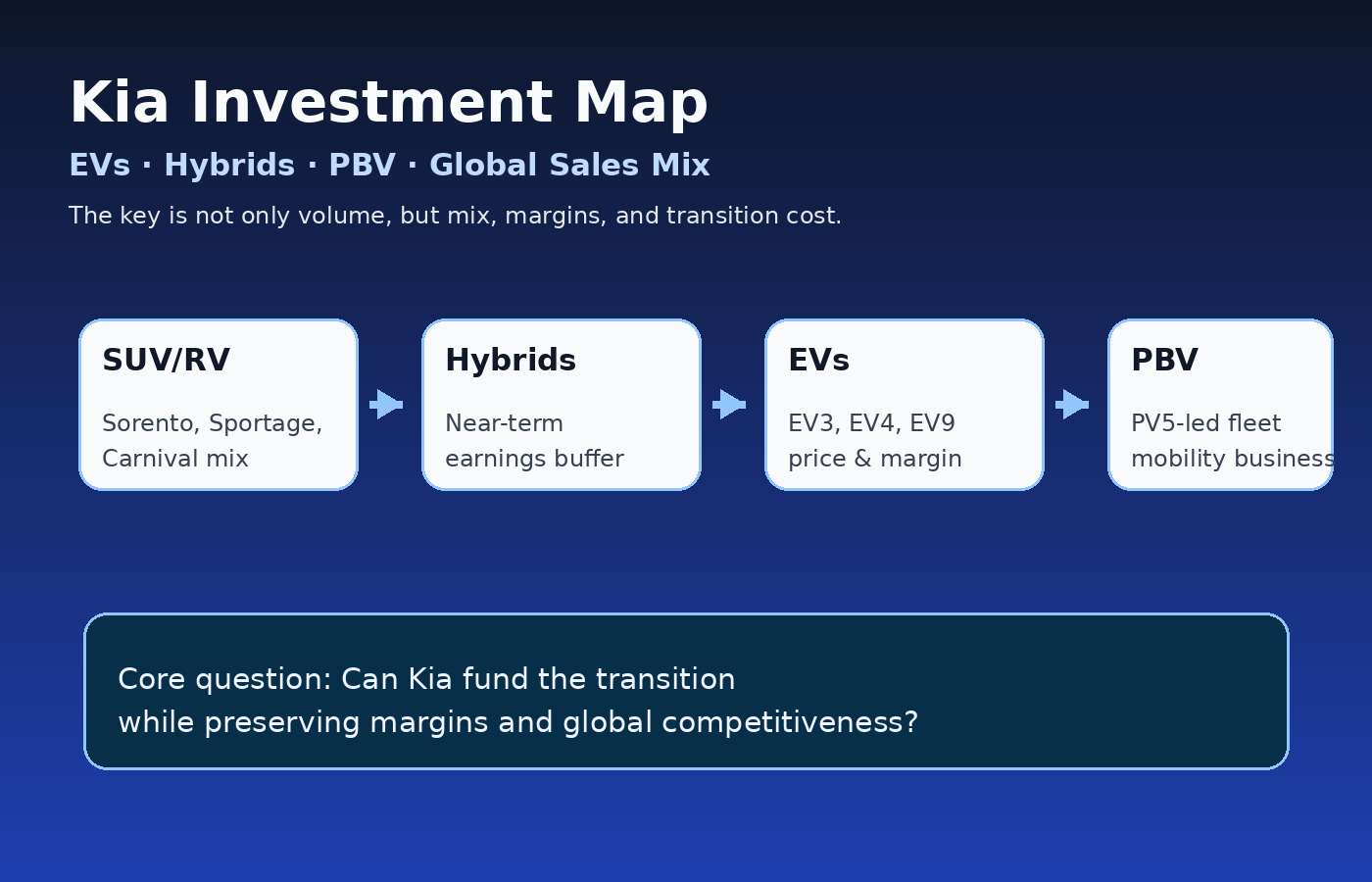
The key question is whether Kia can keep profitable hybrid and SUV/RV sales strong while investing in electric vehicles and PBV without damaging margins.
SUV and RV mix drives profitability
Models such as Sportage, Sorento, and Carnival matter because they influence average selling price, option mix, and brand positioning. If high-margin models remain strong, earnings can be resilient even if total vehicle volume does not surge.
Global sales and FX
Kia is a global exporter and manufacturer. A weaker Korean won can support reported earnings, but the net effect depends on local production, imported components, logistics costs, and regional pricing. FX is an earnings driver, but also a source of volatility.
4. Growth points: EVs, hybrids, and PBV
EV lineup expansion
Kia’s EV strategy is no longer only about early flagship models. The company is widening its lineup across price points and body types with vehicles such as EV3, EV4, EV5, EV6, and EV9. In the current EV market, the decisive factor is not just product quality but price competitiveness and manufacturing cost.
Investors should track EV margin, battery cost, regional subsidies, and inventory/incentive trends. EV volume growth is useful only if it does not permanently dilute profitability.
Hybrids as an earnings bridge
Hybrids are gaining renewed importance because they fit a practical consumer need: better fuel efficiency without full dependence on charging infrastructure. For Kia, hybrids can provide cash flow stability while the EV market matures.
PBV: a big story that still needs numbers
PBV means purpose-built vehicle. Think of delivery vans, taxis, fleet vehicles, mobile services, and vehicles designed around business use cases. Kia’s PV5 strategy matters because it could move the company beyond one-time consumer vehicle sales into fleet and business mobility demand.
However, PBV remains a story that needs proof. Watch actual orders, production capacity, customer adoption, and margins before treating it as a fully proven growth engine.
5. Risks investors should not ignore
- Tariffs and policy: US and European rules, local production requirements, and EV subsidies can change the economics quickly.
- EV price competition: Tesla, Chinese EV makers, and global automakers can pressure margins.
- Quality and recall costs: Warranty expenses or recalls can distort quarterly earnings.
- Consumer cycles: Cars are big-ticket purchases, so interest rates and consumer confidence matter.
- PBV execution risk: PBV is promising, but early investment and slow adoption could disappoint expectations.
The common misunderstanding
Kia should not be read simply as “an EV stock.” Its real story combines EVs, hybrids, SUV/RV profitability, PBV, tariffs, FX, incentives, and quality costs.
6. Investor checklist
- Sales mix: Are SUV/RV, hybrid, and EV shares improving in a profitable way?
- Operating margin: Is Kia maintaining margins without excessive incentives?
- EV progress: Are EV3, EV4, EV9, and other EVs creating real demand and acceptable margins?
- PBV execution: Is PV5 turning into orders, production scale, and fleet customers?
- US and Europe exposure: Are tariffs, subsidies, and local production rules becoming a burden or an advantage?
- FX and costs: How are currency, logistics, battery, and raw material costs affecting margins?
- Shareholder returns: Are dividends, buybacks, and capital policy supported by real earnings power?
7. Conclusion
If you are looking at Kia for the first time, do not reduce it to a simple EV theme. The core investment question is whether Kia can fund the transition to EVs and PBV while preserving the profitability it currently gets from SUVs, RVs, hybrids, and global sales.
The main thing not to misunderstand is that more EV sales do not automatically mean better shareholder value. If EV growth comes with weak margins, high incentives, or rising quality costs, the market may not reward it. Conversely, if hybrid and high-margin vehicle sales stay resilient while PBV begins to produce measurable orders, Kia can be evaluated as a more balanced transition story.
For the next check, watch sales mix, operating margin, EV incentives, PV5/PBV order momentum, tariff exposure, FX, and shareholder return policy. That is the practical dashboard for understanding Kia.
Additional questions for investors
- Separate one-time product revenue from recurring or platform-style revenue.
- Ask what needs to happen before the current news can become visible earnings.
- Compare pricing power, customer base, technology position, and margin profile with competitors.
- Watch operating margin and free cash flow, not only headline revenue growth.
- Consider whether the stock price already reflects an optimistic scenario.
Public sources and editorial basis
This article is an explanatory guide based on publicly available materials such as company investor-relations pages, annual reports, quarterly earnings releases, official product or service announcements, and industry context. It is rewritten in plain language with emphasis on business model, revenue drivers, risks, and practical signals to watch. It is for education and information only, not a buy or sell recommendation.