Olive Young Explained: K-Beauty Platform, CJ Group Value, IPO Expectations, and Key Risks [eng]

Olive Young Explained: Why Korea’s K-Beauty Platform Matters to CJ Group Investors
A plain-English guide to Olive Young’s business model, K-beauty role, IPO expectations, and the risks investors should not ignore.
- Olive Young is one of Korea’s most influential health-and-beauty retail platforms.
- It is not a separately listed stock today, so investors should avoid treating “Olive Young” as a directly tradable public company.
- The story connects K-beauty, offline traffic, online/app sales, private or exclusive products, and CJ Group valuation.
- The main risks are regulation, supplier relationships, competition, consumer slowdown, and valuation expectations around a possible IPO.
If you searched for Olive Young because of K-beauty, CJ Group, or IPO-related market chatter, the first thing to understand is simple: Olive Young is not just a familiar cosmetics store. It has become a major discovery and distribution channel for Korean beauty brands.
For ordinary consumers, Olive Young is where they buy skincare, makeup, health supplements, and lifestyle items. For investors and industry watchers, however, it is more interesting as a K-beauty retail platform: a place where brands gain visibility, products are ranked and reviewed, and customer demand can be converted across both physical stores and online channels.
What is Olive Young?
Olive Young is operated by CJ Olive Young, part of the broader CJ Group ecosystem. Its core business is health-and-beauty retail, covering cosmetics, skincare, makeup, wellness products, inner beauty, and everyday lifestyle items.
The company’s importance comes from its position between brands and consumers. For beauty brands, Olive Young can be a powerful exposure channel. For customers, it is a convenient place to compare new products, check rankings, read reviews, and make repeat purchases. That is why Olive Young’s value is not only about store count; it is also about traffic, curation, data, and brand-launch influence.
Why is it being searched now?
Olive Young attracts attention for three main reasons. First, K-beauty remains an important export and consumer trend. When Korean skincare and makeup brands gain overseas attention, the leading domestic beauty platform naturally becomes more relevant. Second, Olive Young combines offline store traffic with online/app sales, giving it a stronger omnichannel profile than a traditional retailer. Third, its potential IPO and valuation have long been watched as part of the CJ Group investment story.
The key distinction is that investors cannot currently buy “Olive Young stock” as a separately listed company. The market angle usually runs through CJ Group structure, listed CJ affiliates, potential IPO timing, and the wider beauty-retail industry.
Business model: more than a store chain
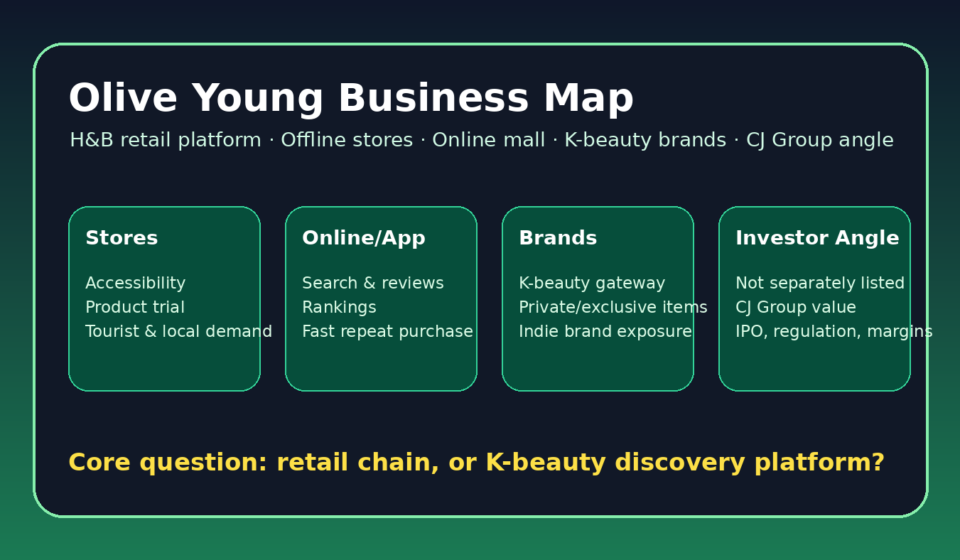
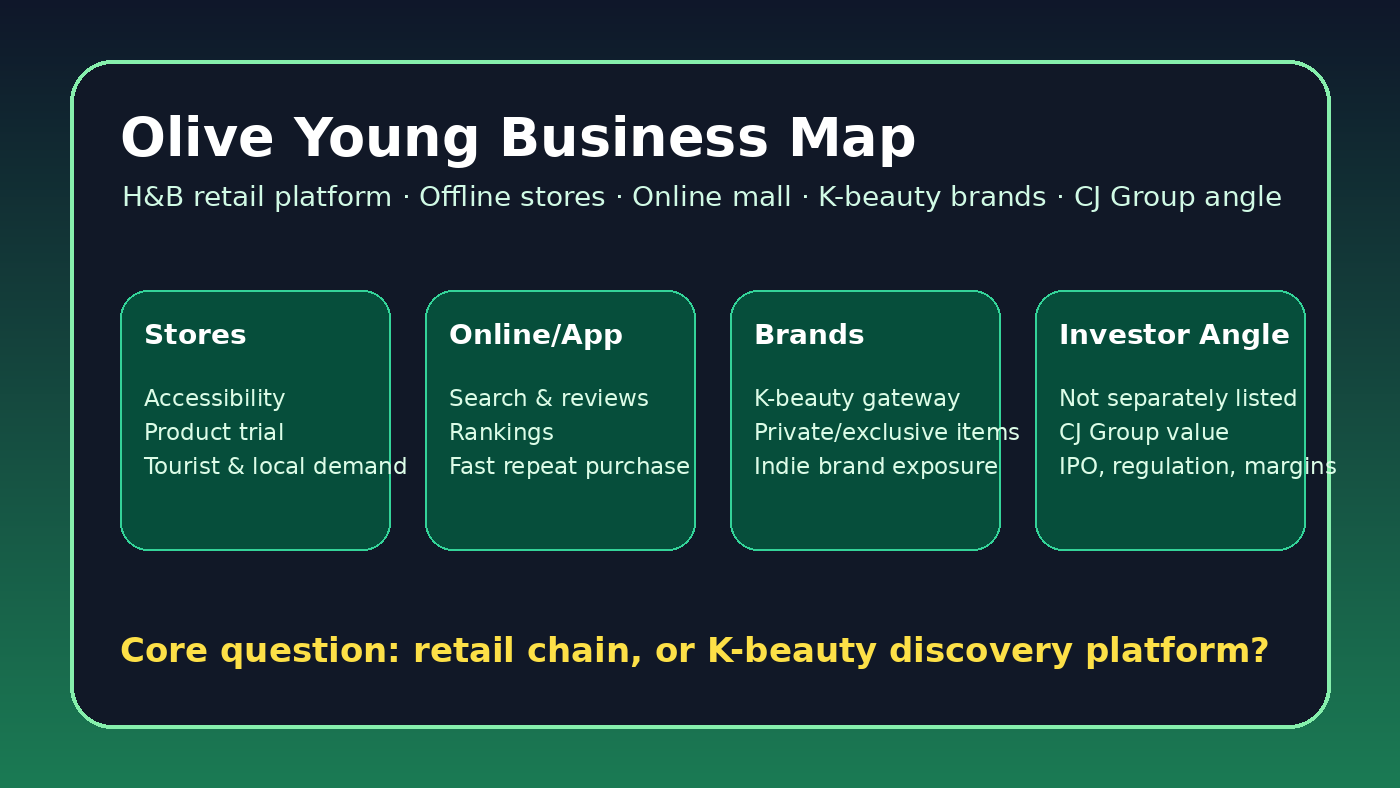
Olive Young should not be read only as a chain of stores that buys and sells products. Its stores provide accessibility, product trial, immediate purchase, and tourist exposure. Its online mall and app provide search, rankings, reviews, delivery convenience, and data-driven repeat purchases.
- Offline stores: access, trial, immediate purchase, tourism demand
- Online mall and app: search, reviews, rankings, fast repeat purchase
- Brand ecosystem: exposure channel for Korean indie beauty brands
- Merchandising power: private-label, exclusive, and curated products
When this structure works, Olive Young becomes more than a sales channel. It becomes a signal of which K-beauty brands are gaining consumer traction.
Growth drivers and positive catalysts
The growth case is tied to K-beauty demand. Korean beauty products are often strong in product speed, pricing, ingredients, packaging, and social-media discovery. Olive Young benefits when consumers want to discover new Korean products in a curated retail environment.
- K-beauty momentum: overseas consumers and tourists can strengthen store and brand relevance.
- Omnichannel behavior: offline discovery can lead to online repeat purchases.
- Brand-launch influence: smaller beauty brands may use Olive Young as a path to wider recognition.
- Category expansion: wellness, inner beauty, men’s grooming, and lifestyle products can broaden the addressable market.
- IPO expectations: even without a confirmed timing, market participants continue to watch how the company may be valued.
Risks and common misunderstandings
The biggest misunderstanding is to treat Olive Young as if it were already a standalone public stock. It is not. That means any investment angle must be framed through CJ Group exposure, related listed companies, or a future IPO scenario rather than direct Olive Young trading.
- Unlisted-company limitation: Olive Young is not directly tradable as a separate listed stock.
- Regulatory risk: large retail platforms can face scrutiny over supplier relationships, fees, and market power.
- Competition: online beauty stores, brand-owned channels, Coupang, Naver, and other platforms remain important.
- Consumer-cycle exposure: cosmetics and wellness spending can slow when consumer sentiment weakens.
- Valuation pressure: IPO expectations can get ahead of actual earnings growth.
Investor checklist
- Whether Olive Young can grow revenue and operating margin at the same time
- How strong online/app traffic and repeat purchases are versus pure store expansion
- Whether K-beauty exports and tourist spending translate into measurable sales momentum
- Any official movement around CJ Group structure, ownership, or IPO timing
- Whether regulatory or supplier-related issues become larger
- Whether beauty brands can grow both inside and outside Olive Young’s channel
Conclusion: read Olive Young as a consumer-platform signal first
If you are looking at Olive Young for the first time, do not misunderstand it as a directly listed stock. The company is not independently traded today, so the investment angle has to be separated into CJ Group value, potential IPO expectations, and the wider K-beauty retail trend.
The core question is this: is Olive Young simply a successful store chain, or is it becoming a powerful K-beauty discovery platform with brand influence and customer data? To answer that, watch margins, online traffic, brand-launch influence, regulatory pressure, and any formal IPO signal.
In short, Olive Young matters less as a single tradable ticker today and more as a signal for K-beauty demand, CJ Group hidden value, and the evolution of Korean retail platforms.
For the Korean version of this article, see 올리브영 한글 페이지.
For Korean consumer-brand context, read Dongwha Pharm and brand power.
For Korean retail and tourism-demand context, see Hyundai Duty Free.
Additional questions for investors
- Separate one-time product revenue from recurring or platform-style revenue.
- Ask what needs to happen before the current news can become visible earnings.
- Compare pricing power, customer base, technology position, and margin profile with competitors.
- Watch operating margin and free cash flow, not only headline revenue growth.
- Consider whether the stock price already reflects an optimistic scenario.
Public sources and editorial basis
This article is an explanatory guide based on publicly available materials such as company investor-relations pages, annual reports, quarterly earnings releases, official product or service announcements, and industry context. It is rewritten in plain language with emphasis on business model, revenue drivers, risks, and practical signals to watch. It is for education and information only, not a buy or sell recommendation.