Why Samsung Electronics Still Stands at the Center of Korea’s Stock Market: Chips, Phones, and AI Strategy [eng]

Why Samsung Electronics Still Stands at the Center of Korea’s Stock Market
An English company-analysis version covering semiconductors, smartphones, foundry strategy, AI positioning, competitors, and valuation checkpoints.
- Samsung Electronics is not just a consumer-electronics brand. It is a multi-layered technology company spanning memory chips, foundry, smartphones, displays, and appliances.
- The heart of the story is still semiconductors, but investors also watch mobile, foundry execution, and AI-device strategy.
- To understand Samsung properly, readers should look at business diversity, competitors, earnings cyclicality, shareholder returns, and the company’s place in the AI era.
One-line summary and company overview
Samsung Electronics is one of the most important listed companies in Korea and one of the most globally recognized names in technology. To many consumers, it is known for Galaxy smartphones, televisions, and home appliances. To the market, however, Samsung is much more than that. It is a broad technology platform built around semiconductors, electronics, displays, and global manufacturing scale.
A useful one-line summary would be this: Samsung Electronics is the company that most clearly reflects Korea’s industrial and technological strengths in a single name. That is why investors often treat Samsung not just as a stock, but as a barometer for Korea’s semiconductor cycle, export momentum, and large-cap market sentiment.
Business structure
Samsung’s business structure is unusually broad. The company operates across memory semiconductors, system semiconductors, foundry services, smartphones, displays, televisions, and other consumer devices. This matters because Samsung is not tied to a single narrative. It can benefit from different trends at different times, but it also has to manage a much more complex operating structure than a focused specialist would.
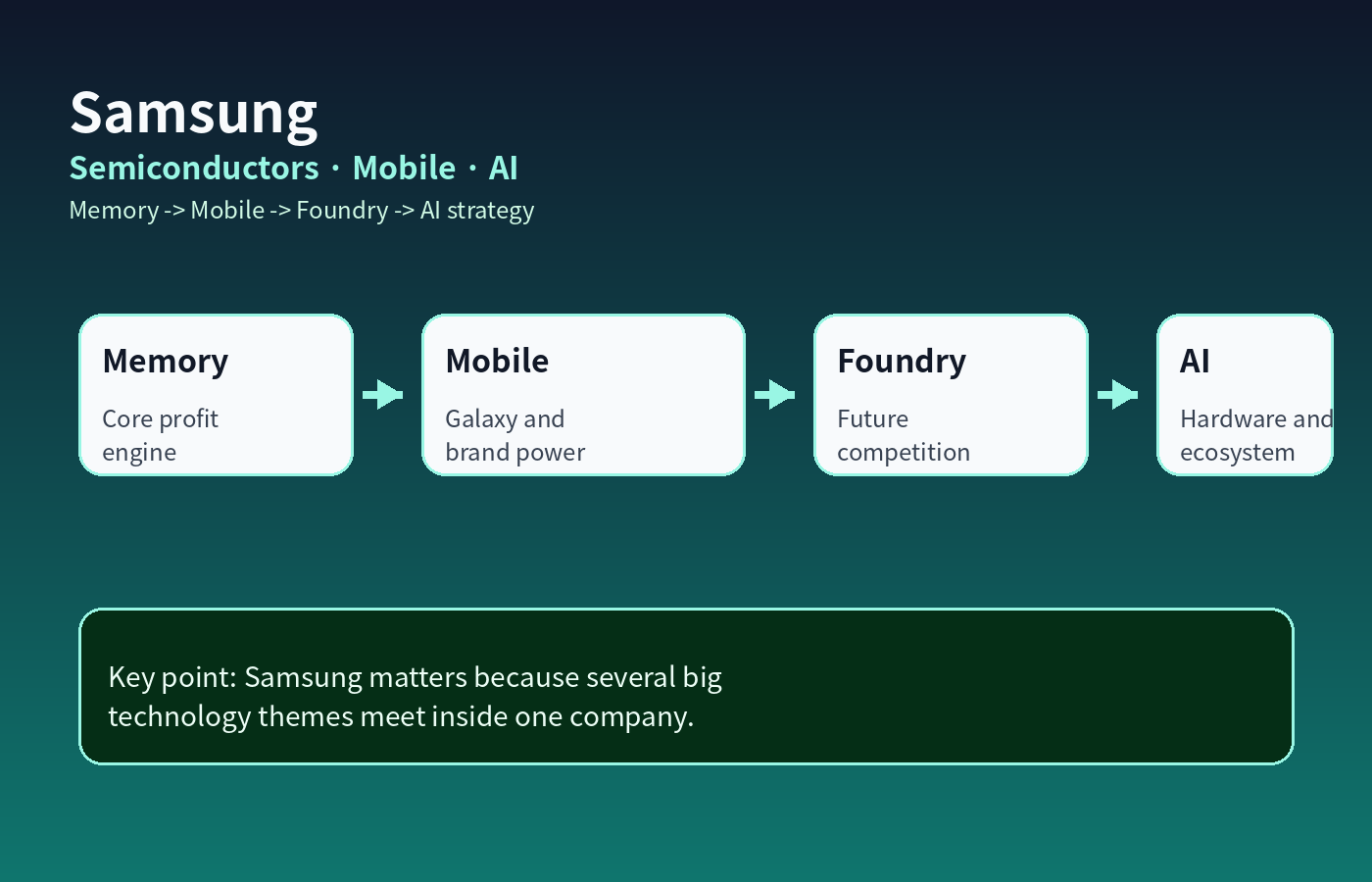
That broad structure is one of Samsung’s biggest strategic strengths. When one segment weakens, another can sometimes provide support. At the same time, the market still tends to treat semiconductors as the core profit engine, which means chip cycles remain central to how investors interpret the stock.
Key products and core pillars
The most visible products are Galaxy smartphones, TVs, and home appliances. But from an investor perspective, the most important pillar is often memory semiconductors. This creates an interesting gap between consumer perception and market interpretation: people may think of Samsung as a device brand, while the market may value it primarily through chip earnings.
- Memory semiconductors — the core earnings and cycle-sensitive engine
- Foundry and system semiconductors — central to long-term technology ambition and strategic competition
- Galaxy smartphones — a major global consumer platform and brand anchor
- Displays and appliances — large-scale consumer businesses that help diversify the company
This is why Samsung is best understood not as a simple electronics manufacturer, but as a company where multiple strategic businesses interact under one giant technology umbrella.
Competitor comparison
Samsung’s competitors change depending on which business segment you focus on. In memory semiconductors, SK hynix is the most direct Korean comparison. In foundry, TSMC is the most important benchmark globally. In smartphones, Apple remains the clearest premium-market comparison, while Chinese manufacturers apply pressure on pricing and market share.
- SK hynix — key comparison in memory, HBM positioning, and cyclical earnings exposure
- TSMC — critical benchmark in foundry technology, execution, and customer trust
- Apple — major comparison in premium smartphones, ecosystem power, and consumer brand strength
- Chinese device makers — important in mass-market competition and pricing pressure
That means Samsung is unusual in that it does not fight just one main rival. It competes in several high-stakes global arenas at the same time.
Strengths
- Business diversification — Samsung is not dependent on a single product line
- Semiconductor scale — chip leadership remains one of the main reasons the company matters globally
- Powerful consumer brand — Galaxy and consumer electronics keep Samsung visible in everyday life
- Manufacturing and capital strength — scale gives Samsung resilience and strategic flexibility
- Large-cap trust and liquidity — investors often see Samsung as a core exposure to Korea itself
These strengths explain why Samsung often remains central to both market narratives and long-term portfolio discussions even when short-term momentum shifts elsewhere.
Weaknesses and risks
- Memory-cycle dependence — despite diversification, semiconductors still drive much of the profit story
- Foundry execution pressure — TSMC remains the toughest benchmark, especially in trust and advanced-node competitiveness
- Mature smartphone market — premium devices remain strong, but explosive growth is harder to sustain
- Chinese competitive pressure — pricing and market-share pressure can weigh on devices and consumer segments
- High expectation burden — the market often demands leadership from Samsung across multiple areas at once
So while Samsung is often seen as a safer large-cap technology name, it still faces serious execution challenges in some of the most competitive global industries.
Financial and valuation checkpoints
When analyzing Samsung, readers should not stop at revenue size. The more useful question is which businesses are driving profitability and how sustainable that profit structure is.
- Revenue — helps show how balanced the company’s broad business mix really is
- Operating profit — especially important because chip cycles can change the earnings picture dramatically
- Margins — useful for judging semiconductor pricing, premium devices, and business-quality trends
- PER — should be interpreted with cyclical context, especially during semiconductor recoveries or slowdowns
- Dividends and shareholder returns — important because many investors view Samsung as a core long-term holding
Samsung is often best understood as a combination of cyclical earnings leverage, strategic technology optionality, and large-cap stability. That mix is exactly what makes valuation interpretation more nuanced than with a pure growth stock.
Current industry trends and Samsung’s position
The biggest technology theme today is obviously AI. Samsung’s role in AI is different from Nvidia’s role as an AI-compute leader. Samsung is better understood as a company supplying and connecting multiple parts of the AI hardware stack: memory, advanced manufacturing, displays, and consumer devices.
That makes several trends especially important. In semiconductors, the market watches HBM and high-performance memory. In foundry, the question is whether Samsung can narrow the execution and trust gap versus TSMC. In devices, the focus shifts to AI-enabled smartphones and on-device AI experiences through the Galaxy ecosystem.
In other words, Samsung’s AI relevance does not come from one single product. It comes from being a multi-layered hardware company connected to memory, manufacturing, and AI-enabled devices at once. That is a very different kind of AI story from the more obvious infrastructure winners, but it is still an important one.
Conclusion
Samsung Electronics still stands at the center of Korea’s stock market not just because it is large, but because it combines semiconductors, devices, manufacturing scale, and global brand power in a way few companies can match.
To understand Samsung properly, readers should go beyond headlines and look at business structure, competitors, earnings cyclicality, AI positioning, and valuation context together.
FAQ
What is Samsung Electronics’ most important business?
Consumers often think first of smartphones, but investors usually treat semiconductors as the most important earnings driver.
How is Samsung different from SK hynix?
Samsung has a much broader structure, including mobile, displays, foundry, and appliances, while SK hynix has more concentrated memory exposure.
What should readers watch first when analyzing Samsung?
Operating profit, semiconductor margins, foundry competitiveness, shareholder returns, and the company’s role in AI hardware are strong starting points.
For the memory-focused Korean comparison, see Why Is Hynix Back in the Spotlight? HBM, AI Chips, and Key Growth Drivers [eng].
For a premium-device and ecosystem comparison, read Why Apple Remains One of the Strongest Brands in the World: iPhone, Services, and AI Strategy [eng].
Additional questions for investors
- Separate one-time product revenue from recurring or platform-style revenue.
- Ask what needs to happen before the current news can become visible earnings.
- Compare pricing power, customer base, technology position, and margin profile with competitors.
- Watch operating margin and free cash flow, not only headline revenue growth.
- Consider whether the stock price already reflects an optimistic scenario.
Public sources and editorial basis
This article is an explanatory guide based on publicly available materials such as company investor-relations pages, annual reports, quarterly earnings releases, official product or service announcements, and industry context. It is rewritten in plain language with emphasis on business model, revenue drivers, risks, and practical signals to watch. It is for education and information only, not a buy or sell recommendation.
Editorial basis and how to read this article
This article is based on publicly available company materials, filings, earnings releases, official announcements, market data, and news context. It is written as a plain-language explainer, not as a short-term price prediction. It is for education and information only and is not a buy or sell recommendation.
Reader checklist
- Check the date and source of key numbers.
- Compare headlines with actual earnings, filings, and market data.
- Look for both growth drivers and risks.
- Separate the business model from the stock narrative.
- Review the next earnings release or official update before making your own decision.