Why Nvidia Sits at the Center of the AI Era: GPUs, Data Centers, and Growth Drivers [eng]

Why Is Nvidia at the Center of the AI Era?
A longer English guide to GPUs, data centers, software ecosystems, and why Nvidia matters so much now.
Nvidia used to be known mainly as a graphics card company, especially in gaming. Today, however, it is viewed as one of the most important companies in the global AI boom.
From graphics to AI infrastructure
The company’s roots are in graphics processing, but the parallel-computing strength of GPUs made them extremely useful for AI training and high-performance workloads.
Why data centers matter
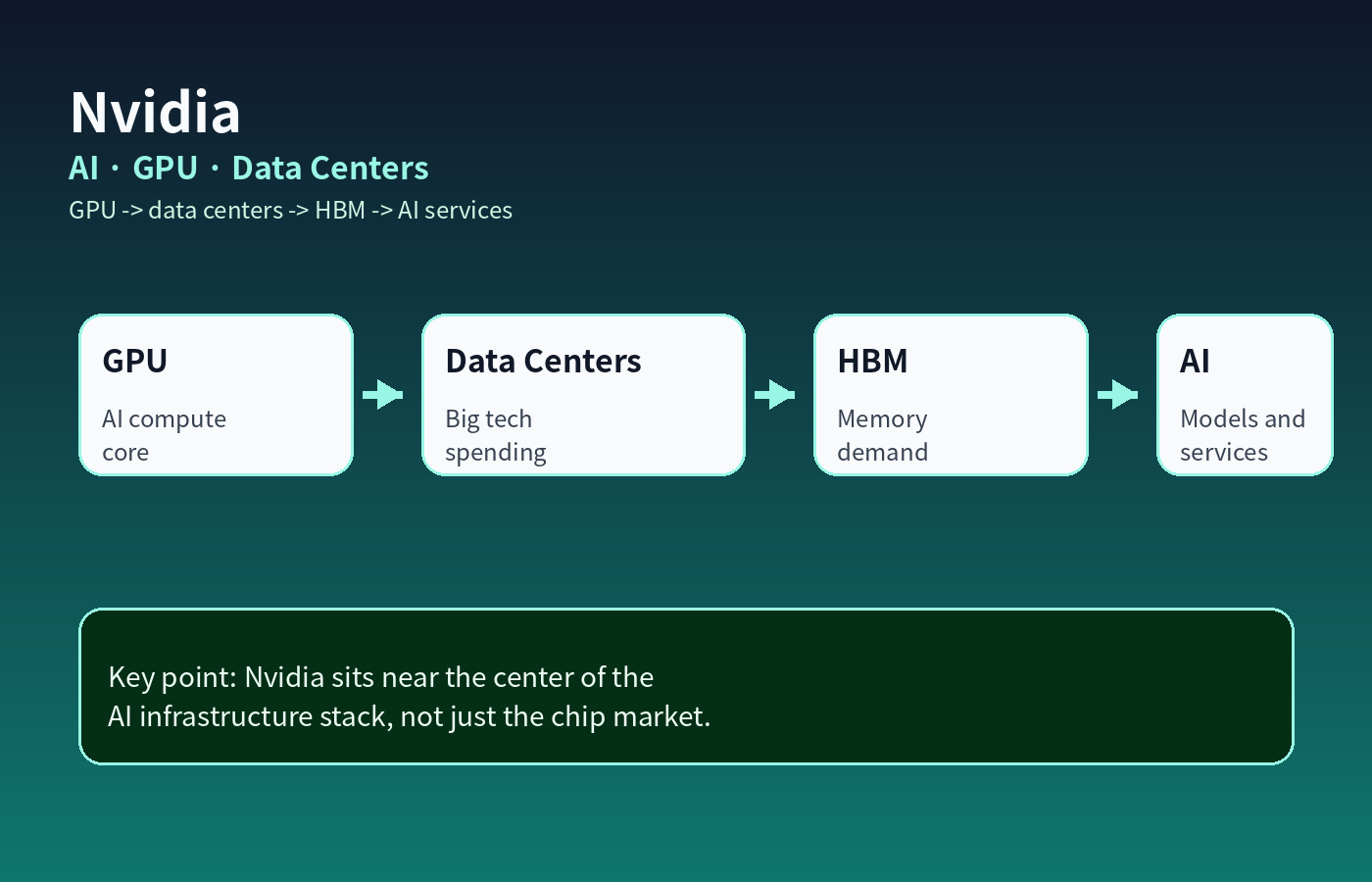
One of the biggest reasons Nvidia has become so important is data center demand. Large technology companies are investing heavily in AI servers, and Nvidia GPUs are often seen as a core part of that infrastructure.
The ecosystem advantage
Nvidia’s influence is not only about hardware. Its software environment, developer tools, and ecosystem lock-in are major reasons it holds such a strong competitive position.
Why this connects to other companies
Nvidia does not stand alone. Its growth is tied to HBM memory, foundry manufacturing, cloud spending, and AI model development.
Main risks to watch
- Valuation pressure — expectations can become difficult to sustain if growth slows.
- Data center spending cycles — AI investment needs to remain strong to support the narrative.
- Competition — AMD, internal chips, and future alternatives all matter.
- Supply chain and manufacturing dependency — ecosystem strength still depends on execution.
- Policy and export restrictions — geopolitical constraints can influence growth paths.
Conclusion
Nvidia matters because it sits near the heart of AI infrastructure.
For the memory side of the AI hardware story, see Why Is Hynix Back in the Spotlight? HBM, AI Chips, and Key Growth Drivers [eng].
Beginner questions investors often ask
Why are GPUs important for AI? AI models require massive parallel computation. GPUs were designed to process many calculations at once, which makes them useful for training and running large AI models.
Is Nvidia only selling chips? Not anymore. Nvidia sells GPUs, networking, systems, software tools, and a developer ecosystem. For many customers, choosing Nvidia is closer to choosing an AI infrastructure platform than buying a single component.
Can the stock fall even if the company is strong? Yes. When expectations are very high, even good results may not be enough. Investors need to compare actual growth, margins, guidance, and supply conditions with what the market already expects.
How Nvidia connects to the wider supply chain
An AI server also needs HBM memory, advanced packaging, substrates, power equipment, cooling, and networking. Nvidia’s growth can therefore influence related companies, but not every “AI semiconductor” company benefits equally. The right question is what each company supplies, how scarce that part is, and whether margins can hold.
What to watch next
- Data-center revenue growth and forward guidance
- New product transitions and supply availability
- HBM, packaging, power, and cooling bottlenecks
- Cloud customers’ AI capital expenditure plans
- Competition from AMD, custom AI chips, and in-house accelerators
Public sources used
This explainer is based on Nvidia Investor Relations materials, quarterly earnings releases, product announcements, and public cloud-company AI infrastructure commentary. For semiconductor basics, see our memory semiconductor guide.
Beginner example: what an AI data center buys
When a company builds AI capability, it does not buy only one chip. It needs GPUs, memory, networking, servers, storage, power equipment, cooling, software tools, and engineers who know how to run the system. Nvidia is powerful because it sits near the center of this spending cycle. Its GPUs are the most visible part, but the surrounding platform and developer ecosystem make the business harder to replace.
This is also why investors watch customer capital expenditure. If large cloud companies keep building AI data centers, Nvidia can continue to see demand. If customers slow spending, use more in-house chips, or optimize existing capacity, growth expectations may need to come down.
How to read Nvidia earnings step by step
Start with data-center revenue. This segment shows how much demand is coming from AI infrastructure customers, including cloud platforms, AI labs, enterprises, and research organizations. If data-center growth remains strong and guidance is also strong, the AI infrastructure cycle is still intact.
Second, watch gross margin. Nvidia’s high margins reflect strong demand, differentiated products, and platform value. If margins weaken during a product transition or due to competition, investors may reassess how durable the growth story is.
Third, check the surrounding supply chain. Nvidia’s growth depends not only on GPU design but also on HBM memory, advanced packaging, networking, power, and cooling. If these bottlenecks become severe, shipments and customer deployment schedules can be affected.
Editorial basis and investment caution
This article is an educational explainer based on publicly available company and industry materials. It is not a buy or sell recommendation and does not promise any investment outcome. Before making decisions, readers should review the latest earnings releases, filings, company disclosures, market conditions, and their own risk tolerance.
Editorial basis and how to read this article
This article is based on publicly available company materials, filings, earnings releases, official announcements, market data, and news context. It is written as a plain-language explainer, not as a short-term price prediction. It is for education and information only and is not a buy or sell recommendation.
Reader checklist
- Check the date and source of key numbers.
- Compare headlines with actual earnings, filings, and market data.
- Look for both growth drivers and risks.
- Separate the business model from the stock narrative.
- Review the next earnings release or official update before making your own decision.