Why Is Hynix Back in the Spotlight? HBM, AI Chips, and Key Growth Drivers [eng]

Why Is Hynix Back in the Spotlight?
A company-analysis version in English covering HBM, memory cycles, competitors, strengths, risks, and valuation checkpoints.
- SK hynix is no longer viewed only as a cyclical memory maker. It is increasingly discussed as a key HBM supplier in the AI era.
- The two biggest forces behind the story are HBM demand and memory-cycle recovery.
- To understand Hynix properly, readers should look at competitors, profit leverage, valuation pressure, and AI infrastructure demand together.
One-line summary and company overview
SK hynix is one of Korea’s flagship memory semiconductor companies, and today it is most strongly associated with HBM and AI infrastructure growth. In the past, the company was often viewed mainly through the lens of memory cycles. Now, the conversation has shifted toward its role in supplying high-performance memory to the AI ecosystem.
A useful one-line summary would be this: SK hynix is a memory-focused semiconductor company that the market increasingly sees as a direct beneficiary of AI-era demand for high-performance memory. That is why it attracts attention not just as a cyclical stock, but as a company positioned near one of the most important technology trends in the market.
Business structure
Hynix’s business structure is centered on memory semiconductors. DRAM and NAND remain the main pillars, and within those categories the market pays close attention to server memory, high-performance memory, and the share of higher-value products.
Compared with Samsung Electronics, Hynix has a narrower structure. That concentration can work both ways. When the memory cycle improves, earnings leverage can look more powerful. But when conditions weaken, the company can also appear more exposed because it does not have as many unrelated business segments to absorb the shock.
Key products and why they matter
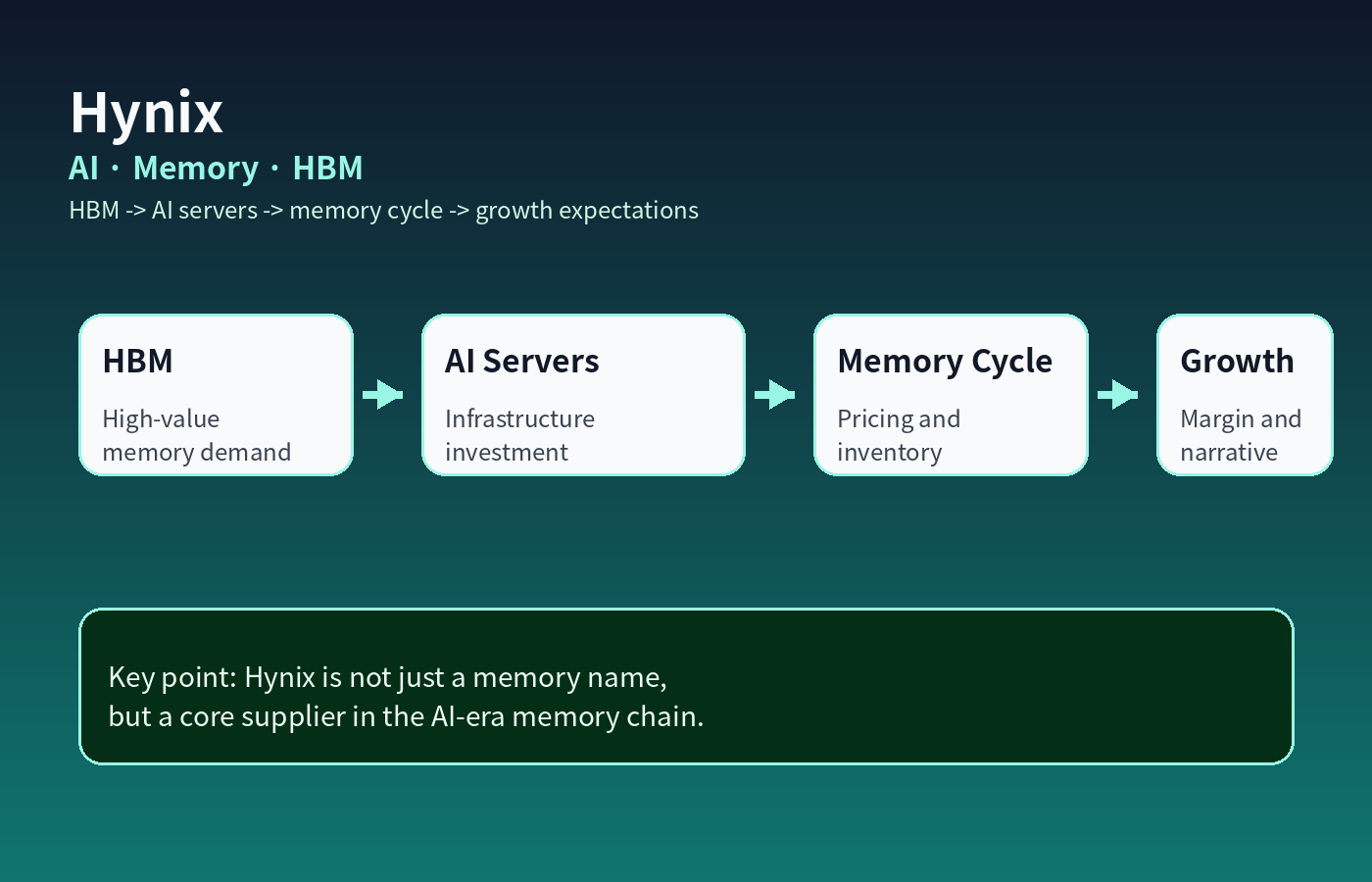
The biggest reason the market has returned to Hynix is HBM. HBM is used in AI servers and advanced GPUs, and it carries greater strategic and pricing importance than standard memory. At the same time, products like DDR5, server DRAM, and other high-performance memory lines also matter because they reflect the company’s position in more demanding infrastructure markets.
That means Hynix is no longer being judged only by how much memory it can ship, but by how much high-value memory it can supply into AI and data-center demand. That shift in perception is central to the current market story.
Competitor comparison
The most direct comparison is still Samsung Electronics. Both companies are major Korean memory players, so the market often compares them through DRAM, NAND, HBM, server exposure, and cyclical recovery potential. A second important comparison is Micron, which gives readers a wider global perspective on memory competition.
- Samsung Electronics — broader business structure, memory plus many other segments
- SK hynix — more concentrated memory exposure, which can create clearer upside or downside in memory cycles
- Micron — important global reference point for memory pricing, demand, and industry expectations
So Hynix stands out as a company with stronger purity of exposure to memory and AI-linked high-performance memory demand.
Strengths
- HBM narrative strength — one of the clearest reasons the market continues to focus on the company
- Memory-cycle leverage — recovery in pricing and utilization can translate strongly into earnings expectations
- Higher-value product mix — the market likes stories where profitability improves through quality, not just volume
- AI infrastructure connection — links naturally to Nvidia, data-center investment, and broader AI buildout themes
These strengths matter because they support both investor narrative and search-driven reader interest. The company sits at a point where macro technology stories and stock-market stories overlap.
Weaknesses and risks
- Heavy dependence on memory cycles — concentration is a strength in upcycles, but a weakness in downturns
- HBM expectations may be priced in early — if the narrative runs ahead of execution, valuation pressure can increase
- Competition — Samsung and Micron remain highly relevant in memory and technology competition
- AI investment slowdown risk — if data-center spending cools, market enthusiasm could weaken quickly
This is why Hynix is best viewed as an attractive but not necessarily comfortable stock story. Strong narratives often come with higher sensitivity to expectation changes.
Financial and valuation checkpoints
When looking at Hynix, readers should not focus only on sales. The more important question is how strongly cycle recovery can translate into profits.
- Sales — useful for seeing whether high-value products are actually contributing more
- Operating profit — one of the clearest signs of memory-cycle recovery and execution quality
- Margins — especially important if the market is expecting product-mix improvement
- PER — useful, but should not be read in isolation during cyclical earnings normalization
- Valuation pressure — investors need to ask how much AI/HBM optimism is already embedded in the stock
In cyclical industries like memory, valuation must be interpreted with earnings context. A simple PER comparison is less useful than understanding where the company sits in the profit cycle.
Current industry trend and Hynix’s position
The most important trend in semiconductors today is clearly AI. As AI infrastructure expands, GPUs and the memory around them become more important. That is exactly where Hynix becomes strategically relevant.
In the past, memory companies were often discussed mainly through PC demand, smartphone demand, and broad server cycles. Today, Hynix is increasingly framed as an AI-era high-performance memory beneficiary. HBM, DDR5, server memory, and data-center capex all reinforce that positioning.
That is why the key question is no longer simply whether Hynix is a memory company. It is whether Hynix can remain a critical memory supplier in the AI buildout for long enough to justify the market’s current enthusiasm.
Conclusion
Hynix matters now not simply because it is a large memory company, but because it sits at the intersection of three powerful themes: HBM, AI infrastructure, and the memory-cycle recovery story.
To understand the company well, readers need to go beyond headlines and stock moves. The bigger picture comes from looking at business concentration, competitor comparison, earnings leverage, and AI-era strategic relevance together.
FAQ
What is the single most important point about Hynix right now?
At the moment, HBM demand tied to AI infrastructure is the clearest reason the company is in focus.
How is Hynix different from Samsung Electronics?
Hynix has more concentrated exposure to memory semiconductors, while Samsung has a much broader business portfolio.
What numbers should readers watch first?
Operating profit, margins, product mix, and how much AI/HBM optimism is already reflected in valuation are especially important.
For a broader Korean large-cap technology comparison, see Samsung Electronics: Why It Still Stands at the Center of Korea’s Stock Market [eng].
For the global AI infrastructure angle, read Why Nvidia Sits at the Center of the AI Era: GPUs, Data Centers, and Growth Drivers [eng].
Additional questions for investors
- Separate one-time product revenue from recurring or platform-style revenue.
- Ask what needs to happen before the current news can become visible earnings.
- Compare pricing power, customer base, technology position, and margin profile with competitors.
- Watch operating margin and free cash flow, not only headline revenue growth.
- Consider whether the stock price already reflects an optimistic scenario.
Public sources and editorial basis
This article is an explanatory guide based on publicly available materials such as company investor-relations pages, annual reports, quarterly earnings releases, official product or service announcements, and industry context. It is rewritten in plain language with emphasis on business model, revenue drivers, risks, and practical signals to watch. It is for education and information only, not a buy or sell recommendation.
How to read SK hynix earnings step by step
Start with DRAM and HBM. SK hynix is closely tied to the memory semiconductor cycle, but HBM has become especially important because AI servers need high-bandwidth memory next to GPUs. Investors should check whether HBM revenue, customer qualification, and capacity expansion are progressing.
Second, watch NAND and inventory. Memory companies can look very strong when prices rise, but oversupply can quickly pressure margins. Inventory levels, pricing trends, and capital expenditure discipline are therefore critical.
Third, compare SK hynix with Samsung Electronics and Micron. The same AI memory theme can affect all three, but customer mix, technology timing, and profitability may differ. A beginner should avoid assuming that every memory company benefits equally.
Public sources and editorial basis
This explainer is based on publicly available company materials such as investor-relations pages, earnings releases, annual reports, and official industry/product commentary. It is written for education and information only, not as a buy or sell recommendation.
What to watch next
- HBM customer qualification and shipment growth
- DRAM and NAND pricing trends
- Inventory levels and capital expenditure discipline
- AI server demand from large cloud customers
- Margin differences versus Samsung Electronics and Micron
Editorial basis and how to read this article
This article is based on publicly available company materials, filings, earnings releases, official announcements, market data, and news context. It is written as a plain-language explainer, not as a short-term price prediction. It is for education and information only and is not a buy or sell recommendation.
Reader checklist
- Check the date and source of key numbers.
- Compare headlines with actual earnings, filings, and market data.
- Look for both growth drivers and risks.
- Separate the business model from the stock narrative.
- Review the next earnings release or official update before making your own decision.