
LG Electronics: Why Investors Should Look Beyond Appliances
LG Electronics is still known for TVs and home appliances, but the investment story increasingly includes vehicle components, commercial HVAC, and the webOS platform.
- LG Electronics should not be viewed only as a traditional appliance and TV company.
- The key question is whether vehicle components, HVAC/B2B, and platform revenue can become large enough to improve the quality of earnings.
- Home appliances remain the cash-flow base, while HVAC and vehicle components provide the longer-term re-rating angle.
- Main risks include weak consumer demand, TV competition, EV-cycle uncertainty, project margins, FX, and input costs.
한국어 버전은 여기에서 볼 수 있습니다.
LG Electronics is a familiar Korean company, but the stock is no longer just a simple “appliance cycle” story. The company still sells refrigerators, washing machines, air conditioners, and TVs around the world. Yet the market now also watches its vehicle-component business, commercial HVAC opportunities, and the monetization of the webOS smart-TV platform.
If you found this page after seeing market chatter about LG Electronics, the practical question is not whether the company has attractive keywords. The better question is this: can LG Electronics turn its new B2B and platform businesses into earnings large enough to change how investors value the company?
What is LG Electronics?
LG Electronics is a global consumer-electronics and technology company based in South Korea. Its core businesses include home appliances, TVs, IT devices, vehicle components, HVAC systems, and enterprise solutions. For ordinary readers, the brand is easiest to understand through refrigerators, washing machines, air conditioners, and OLED TVs. For investors, however, the important point is how each business contributes to margins, cash flow, and future growth.
The home-appliance business is the company’s stabilizing base. TV remains important through OLED positioning and the webOS platform. Vehicle components are tied to the electrification and software-defined vehicle trend. HVAC and B2B solutions are increasingly connected to energy efficiency, commercial buildings, and AI data-center cooling demand.
Why is the stock being discussed now?
Several themes have brought LG Electronics back into focus. First, the expansion of AI data centers has increased interest in power, cooling, and HVAC infrastructure. Companies with commercial air-conditioning and cooling capabilities can attract attention when investors search for beneficiaries of AI infrastructure spending.
Second, cars are becoming more electronic and software-heavy. That makes infotainment systems, power components, electric-vehicle parts, and other vehicle solutions more important. LG Electronics’ vehicle-component segment is therefore watched through the lens of order backlog, profitability, and customer mix.
Third, the TV business is no longer only about selling hardware. Through webOS, LG can pursue advertising, content, and service revenue after the TV is sold. If that platform revenue grows, it could reduce dependence on the highly cyclical TV hardware market.
Business structure: appliances, TV, vehicle components, and B2B
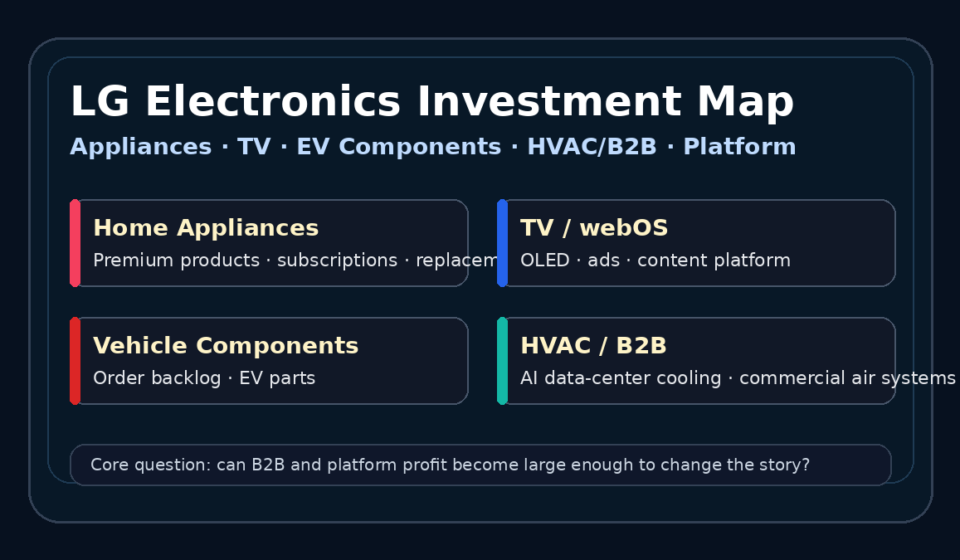
A simple way to read LG Electronics is to divide the company into four investment pillars:
- Home appliances: refrigerators, washing machines, air conditioners, premium products, and subscription/care services.
- TV and webOS: OLED TVs, the smart-TV operating system, advertising, content, and service revenue.
- Vehicle components: infotainment, EV-related parts, vehicle solutions, and order backlog conversion.
- HVAC/B2B: commercial air systems, energy efficiency, building solutions, and data-center cooling demand.
These businesses do not move in exactly the same cycle. Appliances and TVs are more exposed to consumer demand, while vehicle components and B2B/HVAC are more project- and order-driven. If the mix improves, LG Electronics could reduce earnings volatility and support a different valuation argument.
Growth points and positive catalysts
The attractive part of the LG Electronics story is that new growth themes sit on top of an existing global brand and cash-flow base. The company does not need to invent its entire business from scratch. It needs to prove that its newer businesses can become large and profitable enough to matter.
- Premium appliances: strong brand power and high-efficiency products can help defend margins even when broad consumer demand slows.
- Subscription and care services: recurring revenue after product sales could make the appliance business more stable.
- Vehicle components: electrification and software-defined vehicles create a long-term opportunity if backlog converts into profitable sales.
- HVAC and data-center cooling: AI infrastructure growth increases the importance of efficient cooling and commercial air systems.
- webOS platform: advertising, content, and service revenue could make the TV business less dependent on hardware cycles.
Risks and common misunderstandings
The main risk is the gap between a good theme and actual earnings. Vehicle components, HVAC, and platform revenue are attractive ideas, but the market will eventually ask for evidence in revenue growth, operating margin, free cash flow, and order quality.
- Weak consumer demand: appliances and TVs can be hit when replacement demand is delayed.
- TV competition: OLED positioning does not remove pricing pressure or panel-cost risk.
- EV-cycle uncertainty: vehicle components are exposed to automaker production cycles and the pace of EV adoption.
- Project profitability: B2B and HVAC orders are valuable only if margins and execution are controlled.
- FX and input costs: as a global seller, LG Electronics remains exposed to currency, logistics, and raw-material changes.
Investor checklist
- Whether home-appliance margins remain stable, not just whether sales grow.
- The speed at which vehicle-component backlog turns into profitable revenue.
- Commercial HVAC and data-center cooling orders, especially margin quality.
- Whether webOS advertising and content revenue can offset weak TV hardware demand.
- How FX, logistics, and input costs affect quarterly results.
- Whether AI infrastructure, EV, and premium-appliance themes appear in actual numbers.
Conclusion: LG Electronics sits between an appliance cycle stock and a B2B growth story
If you are looking at LG Electronics for the first time, do not misunderstand the story. This is still a company with large exposure to appliances and TVs, so consumer demand matters. It is not automatically a pure AI infrastructure, EV, or software-platform stock just because those keywords are present.
The core investment question is whether the newer growth pillars can reduce the volatility of the traditional consumer-electronics business and improve the quality of earnings. To answer that, watch vehicle-component backlog conversion, HVAC profitability, webOS revenue, appliance margins, and cost variables together.
In short, LG Electronics is trying to build a broader story on top of its established appliance and TV base: premium appliances for cash flow, vehicle components and HVAC for B2B growth, and webOS for platform revenue. The next thing to check is not the headline theme, but whether those businesses are showing up in operating profit and cash flow.
For a broader Korean electronics comparison, see the Samsung Electronics analysis.
For the component angle, compare with Samsung Electro-Mechanics, and for auto demand, see the Kia analysis.
For AI infrastructure and semiconductor demand, read the Nvidia analysis and the memory semiconductor guide.
Additional questions for investors
- Separate one-time product revenue from recurring or platform-style revenue.
- Ask what needs to happen before the current news can become visible earnings.
- Compare pricing power, customer base, technology position, and margin profile with competitors.
- Watch operating margin and free cash flow, not only headline revenue growth.
- Consider whether the stock price already reflects an optimistic scenario.
Public sources and editorial basis
This article is an explanatory guide based on publicly available materials such as company investor-relations pages, annual reports, quarterly earnings releases, official product or service announcements, and industry context. It is rewritten in plain language with emphasis on business model, revenue drivers, risks, and practical signals to watch. It is for education and information only, not a buy or sell recommendation.