Hyundai Duty Free: Profit Turnaround, Incheon Airport, and Hyundai Department Store Impact [eng]

Hyundai Duty Free: Profit Turnaround, Incheon Airport, and What It Means for Hyundai Department Store
A plain-English guide to Hyundai Duty Free’s business structure, recent profit-turnaround story, airport and online duty-free competition, and why investors should view it through Hyundai Department Store rather than as a separately listed stock.
- Hyundai Duty Free is the duty-free business of Hyundai Department Store Group, operating through airport, downtown, and online channels.
- The current story is about profit turnaround, Incheon Airport duty-free operations, and recovering outbound travel demand.
- Hyundai Duty Free is not a separately listed company, so investors should analyze its impact through Hyundai Department Store and the group’s retail earnings.
What is Hyundai Duty Free?
The first thing to understand is that Hyundai Duty Free is not a separately listed stock. Investors cannot simply buy “Hyundai Duty Free” as an independent listed company. The investment angle is mainly through Hyundai Department Store and Hyundai Department Store Group, where the duty-free business can affect earnings quality, sentiment, and the broader retail story.
Hyundai Duty Free is the duty-free retail brand operated by Hyundai DF, part of Hyundai Department Store Group. For consumers, it is familiar as a place to buy cosmetics, perfume, liquor, fashion accessories, and luxury goods before international travel, either at the airport or through online duty-free reservations.
A duty-free shop is not just a discount store. It sells tax-free products to outbound travelers and connects brands with travelers through airport, downtown, and online channels. To understand Hyundai Duty Free, readers need to look at travel demand, airport passenger traffic, foreign tourists, exchange rates, luxury consumption, and beauty demand.
Why it is being watched now
Hyundai Duty Free is being watched first because of its profit-turnaround story. Korean media reports recently highlighted that the company moved into the black and even raised base wages after a period of wage freezes. That is not just an internal labor issue. It can also be read as a sign that profitability in the duty-free business has improved from a difficult period.
The second reason is Incheon Airport. Incheon Airport is one of the most important channels in Korea’s duty-free industry. Airport duty-free stores offer strong brand exposure and direct access to outbound travelers, but they also come with high rent and operating costs. The key is whether Hyundai Duty Free can turn airport traffic into sustainable profit, not just sales.
The third reason is the recovery in overseas travel. As more Koreans travel abroad and foreign visitors return, duty-free shopping demand can recover. But the post-pandemic duty-free market is different from the old market. It is less dependent on bulk Chinese reseller demand and more focused on individual travelers, online reservations, membership benefits, and profitable product mix.
Business structure: airport, downtown, online duty free
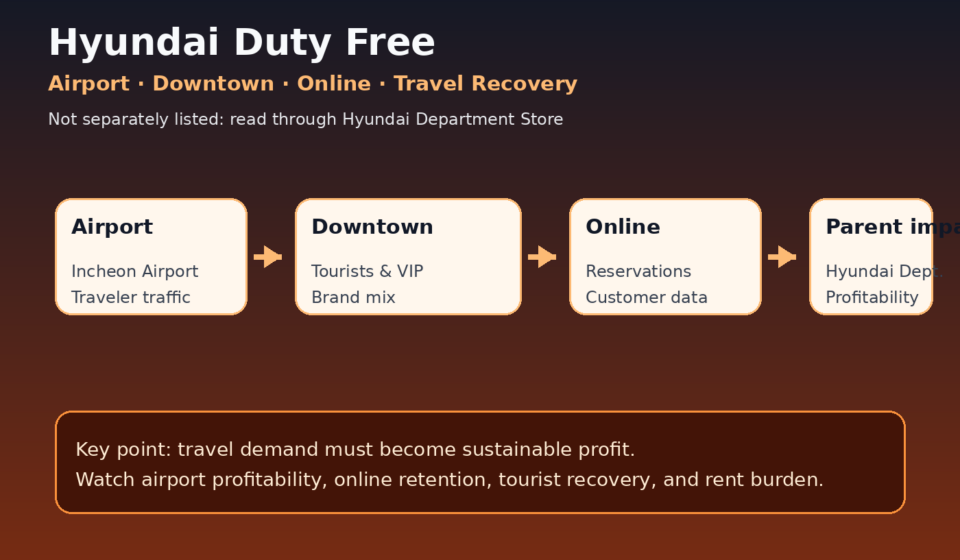
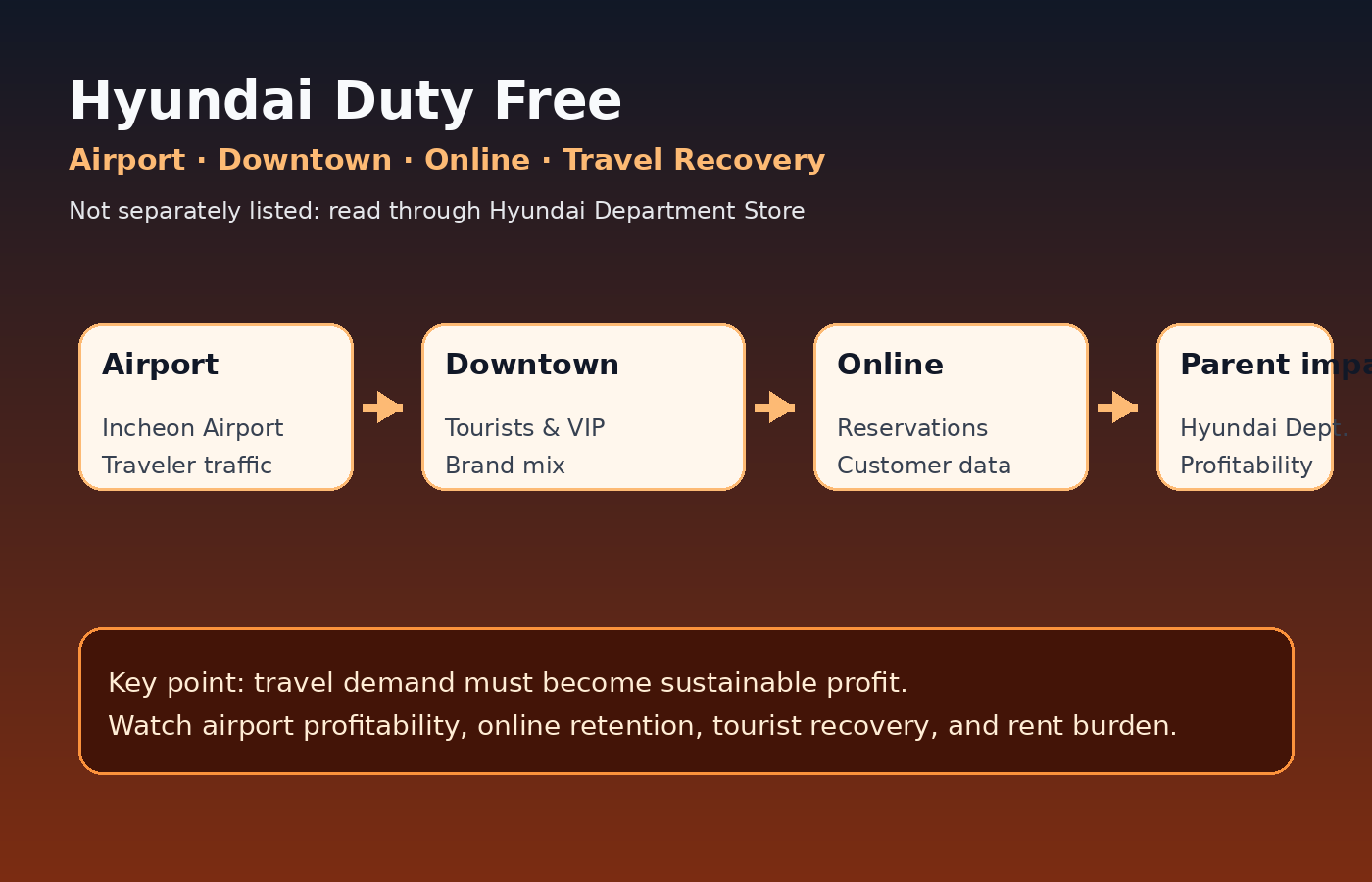
Hyundai Duty Free can be understood through three channels: airport stores, downtown stores, and online duty-free retail. Airport duty-free is the most visible channel for departing travelers. It matters for brand exposure and sales scale, but rent and operating expenses can pressure margins.
Downtown duty-free stores serve travelers who shop before departure. In the past, the business was heavily influenced by Chinese group tourists and bulk buyers. Today, individual travelers, VIP customers, membership programs, and product selection matter more.
Online duty free lets customers reserve products on mobile or web before picking them up at the airport. It is competitive because price comparisons and promotions are easy, but it also helps the company collect customer data and encourage repeat purchases.
Industry context and Hyundai Department Store impact
The duty-free industry benefits when travel demand recovers. More outbound travelers generally mean more airport traffic and more opportunities for pre-departure shopping. Cosmetics, perfume, liquor, fashion, and luxury accessories are typical duty-free categories.
However, the industry is more difficult than before. The old growth model based on large-scale Chinese tour groups and reseller demand is weaker. Competition with department stores, outlets, overseas direct purchases, brand-owned online stores, and other duty-free operators remains intense.
This is where Hyundai Department Store investors should pay attention. If the duty-free business generates stable profits, it can become part of a recovery story for the group’s retail portfolio. If airport rent, discount competition, or weak tourist spending pressure margins, it can remain a burden even if the department-store business itself is stable.
Growth drivers and positives
The first positive is travel recovery. More outbound travel can increase both airport-store traffic and online duty-free reservations. Peak travel seasons such as summer holidays, Chuseok, year-end travel, and long-haul tourism can support demand.
The second positive is Hyundai Department Store Group’s retail experience. The group has experience in brand relationships, VIP customer management, store operations, and membership programs. These strengths can help Hyundai Duty Free compete on product mix and customer experience rather than only on price.
The third positive is the profit-turnaround signal. If the business can keep generating profit after a difficult cycle, the market may start treating duty free as a recovering asset rather than only as a cost burden.
Risks and weak points
The first risk is rent and fixed costs. Airport duty-free stores can be expensive to operate. Even if sales recover, high rent, labor costs, and promotions can limit profitability.
The second risk is exchange rates and consumer sentiment. If the Korean won weakens sharply or the economy becomes uncertain, travelers may reduce shopping budgets. Duty-free sales depend not only on travel volume, but also on actual purchasing power.
The third risk is competition and foreign tourist demand. The industry remains sensitive to Chinese and Asian tourist flows, while competitors such as Lotte, Shilla, and Shinsegae remain strong. Hyundai Duty Free must prove that it can differentiate itself and earn sustainable margins.
Investor checklist
- Listing structure — Hyundai Duty Free is not separately listed, so connect the story to Hyundai Department Store earnings and sentiment.
- Profit sustainability — Is the recent turnaround a one-time effect or a structural improvement?
- Incheon Airport profitability — Are airport operations profitable after rent and operating costs?
- Outbound travel demand — Are Korean travelers and foreign tourists continuing to recover?
- Online duty-free strength — Is the company building repeat customers instead of relying only on discounts?
- Product mix — Are higher-margin categories such as beauty, liquor, luxury, and fashion improving?
Conclusion
If you searched Hyundai Duty Free because of the profit-turnaround headlines, the most important point is this: Hyundai Duty Free is not a separate listed company. The relevant investment question is not “Can I buy Hyundai Duty Free stock?” but “Does the duty-free recovery improve Hyundai Department Store’s earnings and investor perception?”
The core question is whether the turnaround is temporary or a sign that the group’s duty-free business is becoming structurally healthier. To judge that, watch Incheon Airport profitability, duty-free operating contribution, online customer retention, foreign tourist recovery, and rent burden.
In short, Hyundai Duty Free is a useful keyword for understanding Korea’s travel-retail recovery, but investors should read it through Hyundai Department Store and the broader retail portfolio. Do not stop at “more travelers equals good news.” The real test is whether travel demand turns into sustainable profit.
For the Korean version of this article, see 현대면세점 한글 페이지.
For broader Korean company context, see Hyundai Motor and Samsung Electronics.
※ This article is for company and industry understanding only. It is not investment advice. Always check the latest filings, earnings, and your own criteria before making investment decisions.
Additional questions for investors
- Separate one-time product revenue from recurring or platform-style revenue.
- Ask what needs to happen before the current news can become visible earnings.
- Compare pricing power, customer base, technology position, and margin profile with competitors.
- Watch operating margin and free cash flow, not only headline revenue growth.
- Consider whether the stock price already reflects an optimistic scenario.
Public sources and editorial basis
This article is an explanatory guide based on publicly available materials such as company investor-relations pages, annual reports, quarterly earnings releases, official product or service announcements, and industry context. It is rewritten in plain language with emphasis on business model, revenue drivers, risks, and practical signals to watch. It is for education and information only, not a buy or sell recommendation.