Samsung Electro-Mechanics: Why AI Substrates, MLCC, and Foreign Buying Matter Now [eng]

Samsung Electro-Mechanics: Why AI Substrates, MLCC, and Foreign Buying Matter Now
A plain-English guide to Samsung Electro-Mechanics’ business model, MLCC, package substrates, AI server demand, recent foreign investor interest, and the key risks to watch.
- Samsung Electro-Mechanics is a core electronic components company focused on MLCC, package substrates, and camera modules.
- The market is paying attention to AI server substrates, high-value MLCC demand, and foreign investor buying.
- The opportunity is real, but investors still need to watch stock volatility, component cycles, and the timing of new substrate investments.
What is Samsung Electro-Mechanics?
Samsung Electro-Mechanics is the electronic components arm of the Samsung Group. It is less visible to everyday consumers than Samsung Electronics, but its products sit inside smartphones, servers, cars, communication equipment, and many other electronic devices. The company is best understood through three keywords: MLCC, package substrates, and camera modules.
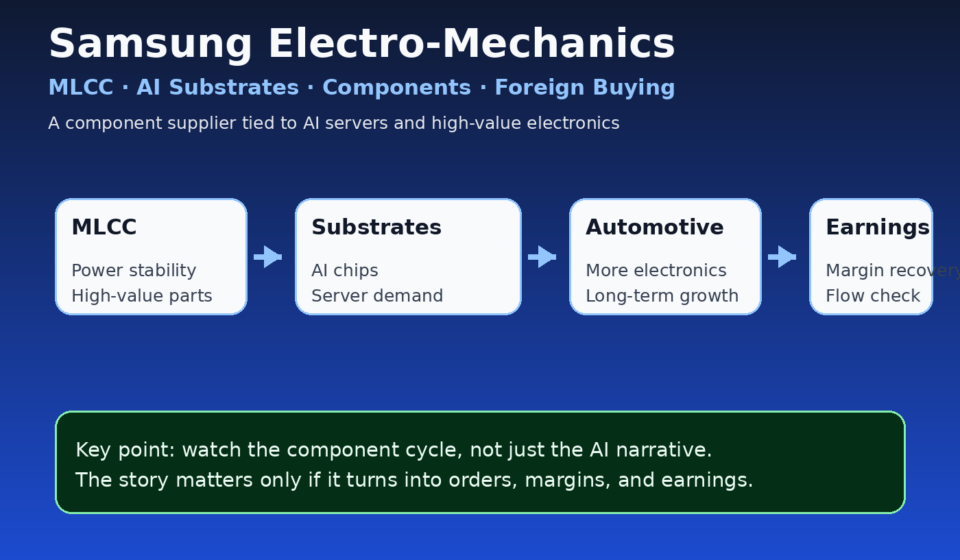
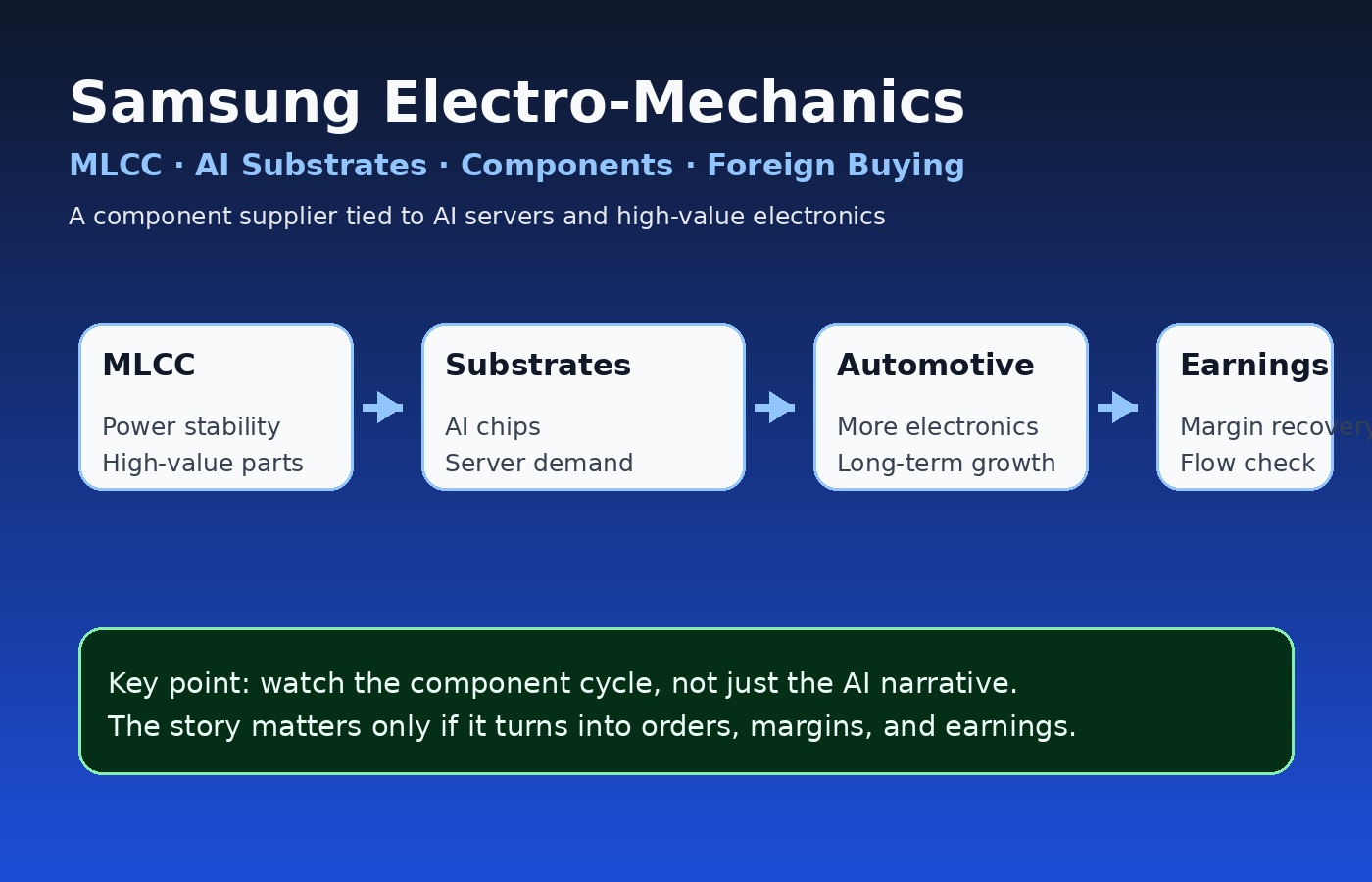
MLCC, short for multilayer ceramic capacitor, is a tiny but essential component that stabilizes electrical current in circuits. A single smartphone can contain hundreds of MLCCs, and more advanced products such as electric vehicles and AI servers can require higher-performance components. Package substrates connect semiconductor chips to boards, and they become more important as chips become faster, hotter, and more complex.
In simple terms, Samsung Electro-Mechanics is not a consumer-facing product company. It is a supplier of the critical components that make modern electronics, AI infrastructure, vehicles, and mobile devices work reliably.
Why the stock is being watched now
Samsung Electro-Mechanics is drawing attention for three main reasons. The first is the growth of AI infrastructure. AI servers require high-performance semiconductors, advanced substrates, stable power delivery, and reliable electronic components. That connects Samsung Electro-Mechanics’ MLCC and substrate businesses to the broader AI investment cycle.
The second reason is foreign investor activity. Recent Korean market reports highlighted that foreign investors continued to show interest in Samsung Electro-Mechanics even after sharp share-price weakness. Foreign buying does not guarantee future returns, but it often signals that some investors are looking beyond short-term volatility and focusing on medium- to long-term earnings potential.
The third reason is improving earnings expectations from parts of the analyst community. Some market commentary has pointed to AI substrates and higher-margin MLCC products as possible drivers of future profit growth. The important shift is that investors are starting to view Samsung Electro-Mechanics not only as a smartphone component supplier, but also as a potential AI infrastructure component play.
Business structure: MLCC, substrates, camera modules
The first core business is MLCC. MLCCs are essential for stabilizing power and signals in electronic devices. The business can be cyclical because it depends on inventory levels and demand from end markets such as smartphones, PCs, servers, and automobiles. However, high-value MLCC products for servers and vehicles can improve profitability when demand is strong.
The second core business is package substrates. As semiconductors become more powerful, substrate technology becomes more demanding. AI accelerators, advanced processors, and server chips require reliable substrates that can handle complex signal and power requirements. This is why the substrate segment is central to the company’s potential re-rating.
The third business is camera modules. Smartphone camera performance remains an important selling point for premium devices, and Samsung Electro-Mechanics has long been active in this area. Still, because the smartphone market is no longer growing as rapidly as before, investors tend to focus more on the growth potential of MLCC and substrates.
AI servers and the component opportunity
When people discuss the AI boom, they usually mention Nvidia, AMD, SK hynix, Samsung Electronics, or other semiconductor names. But AI servers are not built with GPUs and memory alone. They also need power-stabilizing components, advanced packaging, high-performance boards, and reliable signal connections.
Samsung Electro-Mechanics is connected to this theme through MLCC and package substrates. AI servers consume significant power and operate under demanding conditions, so the quality of components matters. If demand for AI servers continues to expand, high-value MLCC and server-related substrate demand could become an important earnings driver.
That said, investors should not assume that AI demand will automatically translate into explosive earnings. The key is whether the company can turn the theme into actual orders, higher utilization, better margins, and broader customer relationships. The market will eventually demand proof in the numbers.
Growth drivers and strengths
The first strength is technical difficulty. High-end MLCC and advanced substrates require manufacturing know-how, customer qualification, and quality control. These are not products that can be copied overnight simply by adding equipment.
The second strength is exposure to multiple industries. Samsung Electro-Mechanics’ components can be used in smartphones, cars, servers, data centers, networking equipment, and industrial electronics. That gives the company more ways to benefit when one end market slows but another improves.
The third strength is its connection to AI infrastructure. If AI server investment remains strong, the company may benefit indirectly through higher-value components. This is why AI substrates and MLCC have become central to the investment story.
Risks and uncertainties
The first risk is share-price volatility. Samsung Electro-Mechanics has recently shown sharp price swings despite positive long-term expectations. Stocks with high expectations can fall quickly when earnings, sentiment, or market liquidity disappoint.
The second risk is the component cycle. MLCC and substrates are tied to demand from end markets. If smartphones, PCs, servers, or autos are weaker than expected, recovery in utilization and margins may take longer.
The third risk is investment timing. Newer opportunities such as glass substrates can attract strong market attention, but delays in equipment orders, qualification, or customer adoption can cool investor expectations. Investors should track whether new investments move from narrative to actual production and revenue.
Investor checklist
- MLCC margins — Are high-value products lifting profitability?
- Package substrate demand — Is AI server and high-performance semiconductor demand translating into revenue?
- Foreign investor flow — Is foreign buying a short-term trade or a sustained ownership trend?
- Investment schedule — Are glass substrate and other new growth projects moving on time?
- Customer diversification — Is the company reducing reliance on specific end markets and expanding server/automotive customers?
Conclusion
Samsung Electro-Mechanics should not be viewed only as a smartphone component supplier. Through MLCC and package substrates, it is connected to AI servers, automotive electronics, and high-performance semiconductor infrastructure. Recent foreign investor interest and positive analyst commentary reflect that changing perception.
However, the investment case still needs confirmation through earnings. Component cycles, margin recovery, substrate demand, and new investment schedules all matter. The central question is whether the AI and high-value component story can turn into real revenue and profit improvement.
In short, Samsung Electro-Mechanics can be seen as an indirect AI infrastructure beneficiary, but it is not a risk-free AI stock. Investors should focus on MLCC profitability, package substrate revenue, foreign investor flows, and the timing of new substrate investments before drawing a strong conclusion.
For the Korean version of this article, see 삼성전기 한글 페이지.
For broader AI semiconductor context, see Nvidia, Memory Semiconductor Guide, and Samsung Electronics.
※ This article is for company and industry understanding only. It is not investment advice. Always check the latest filings, earnings, and your own criteria before making investment decisions.
Additional questions for investors
- Separate one-time product revenue from recurring or platform-style revenue.
- Ask what needs to happen before the current news can become visible earnings.
- Compare pricing power, customer base, technology position, and margin profile with competitors.
- Watch operating margin and free cash flow, not only headline revenue growth.
- Consider whether the stock price already reflects an optimistic scenario.
Public sources and editorial basis
This article is an explanatory guide based on publicly available materials such as company investor-relations pages, annual reports, quarterly earnings releases, official product or service announcements, and industry context. It is rewritten in plain language with emphasis on business model, revenue drivers, risks, and practical signals to watch. It is for education and information only, not a buy or sell recommendation.